November & December 2024

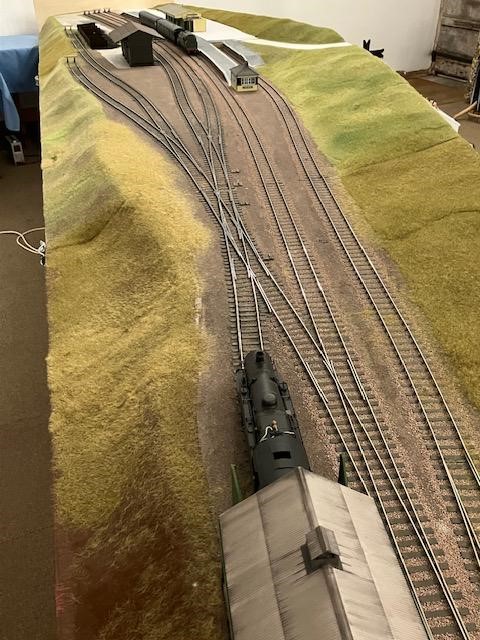
First a reminder that The Summit is all set to be on show at Model Rail Scotland at the SEC, Glasgow over the weekend of Friday 21st to Sunday 23rd February (a three day show). This enormous 7mm Scale 0 Gauge scenic layout is based on the railway between Settle and Carlisle, requires a lorry and a large team to transport erect and operate it, and exhibiting The Summit is a major undertaking. It’s not unheard of for visiting locos to be given running rights, and our layout has been used at exhibitions to test locos before purchase. If you’re at the show please come along and say hello, and we’ll take it from there!
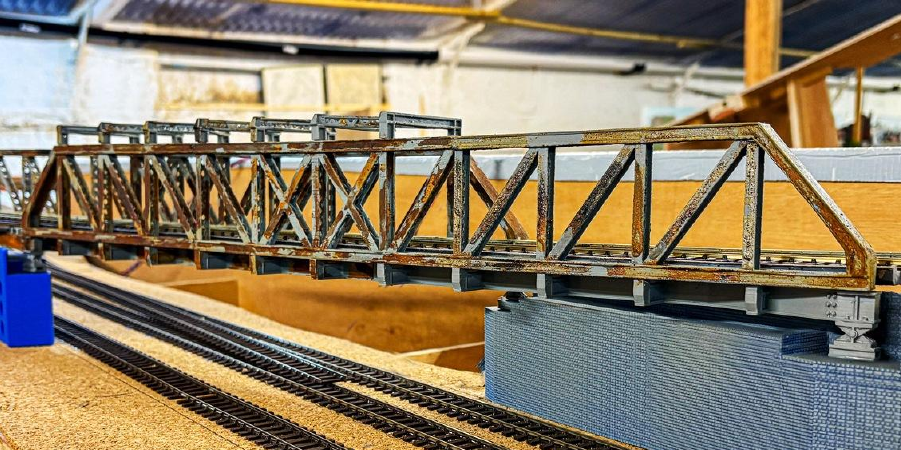
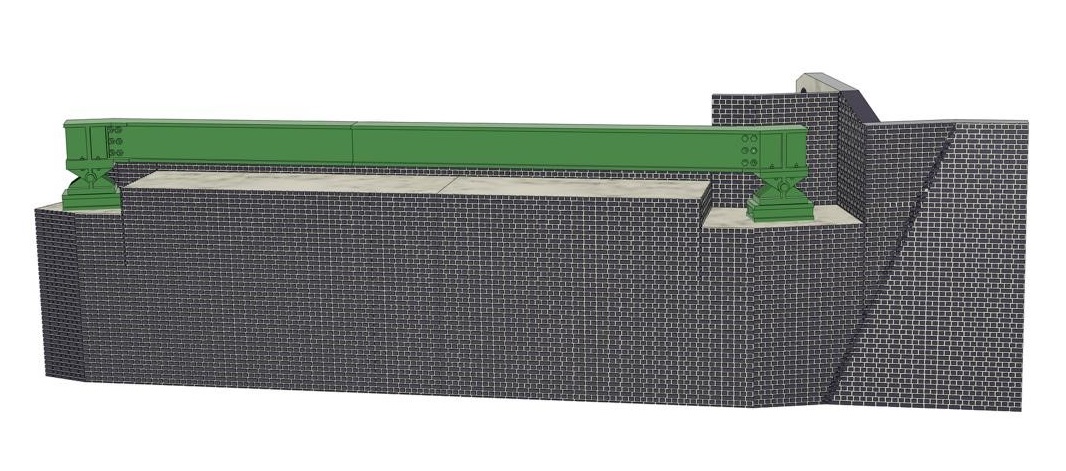
Over the past few months, Andrew has been working on the impressive flyover bridge for our 00 Gauge Heyno Junction club layout. The design was first created using CAD software, and the structure was divided into 12 sections for 3D filament printing. Once assembled, the bridge was painted grey, and Deluxe Materials’ Rust-It solution was used to give it a weathered, rusty appearance. To enhance its realism, further weathering is planned to make it look like it has stood the test of time. For the brick supports, he intends to clad the existing blocks with laser-cut plywood featuring a brick pattern, as the 3D CAD generated filament printed brickwork did not meet his expectations.

Allan has just finished this splendid 7mm model of the signal box at Cole in anticipation of his future layout of Cole station on the S&D which will replace Kingsferry in his railway shed.

It is constructed in card and Plastikard entirely from photographs as it was demolished when the line closed in 1966. It represents the signal box pre-nationalisation when the chimney was extant. It is finished in the brown and cream of the LMS parent company. Perhaps Allan was concerned that the Southern vivid green and cream would have shown up his collection of GWR engines in that dull browny-green so beloved of Swindon. A superb S&D model by an enthusiast for all things GWR – whatever next?!

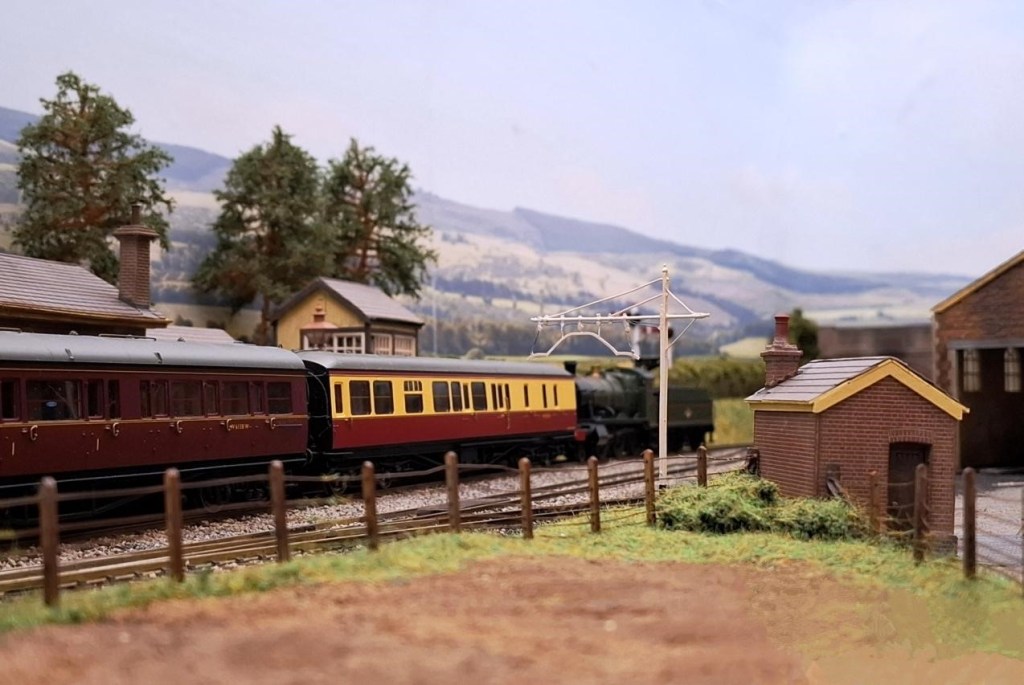
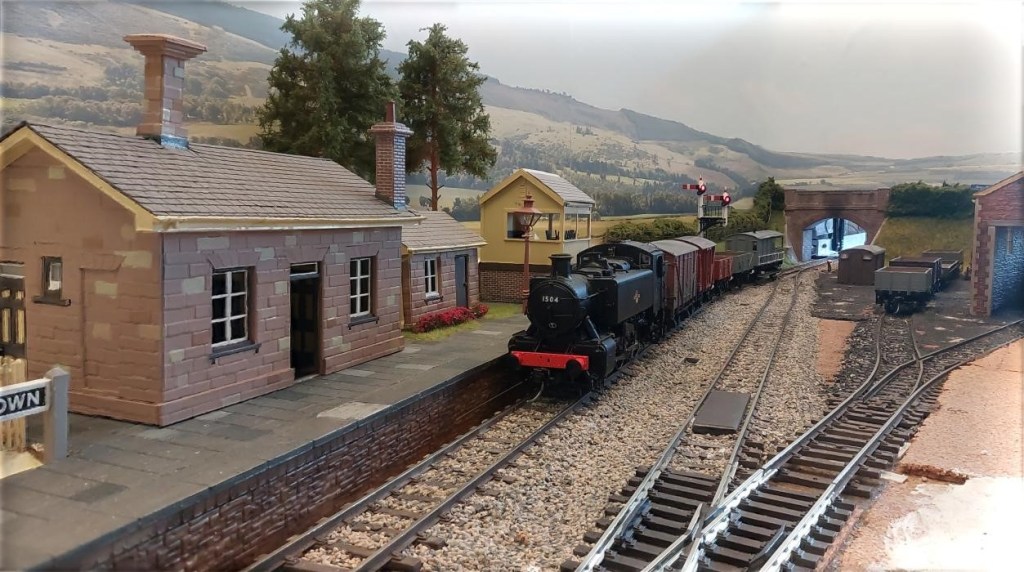
2024 was a good year for 4mm scale Coombe Town as Dom managed to complete some major scenic projects including finishing the exterior of all the station buildings, adding the yard ground cover and building up the field in the front corner of the layout. All this has allowed him to start photographing some of the views he’s been aiming for the last five years, one of which is included here. 2025 will hopefully see the completion of major works with the road and Station Master’s house currently under construction, with the garden to follow to complete basic ground cover across the layout. Your editor reckons the overall look and that backscene are pure genius!

Simon K has completed the weathering of Alice for his 7mm scale NG Tynradd layout.

And Tynradd virtually complete – electrics to be finished and the buildings shown previously to be positioned in the far right corner. Anyone wondering about the name could just try reading it backwards…
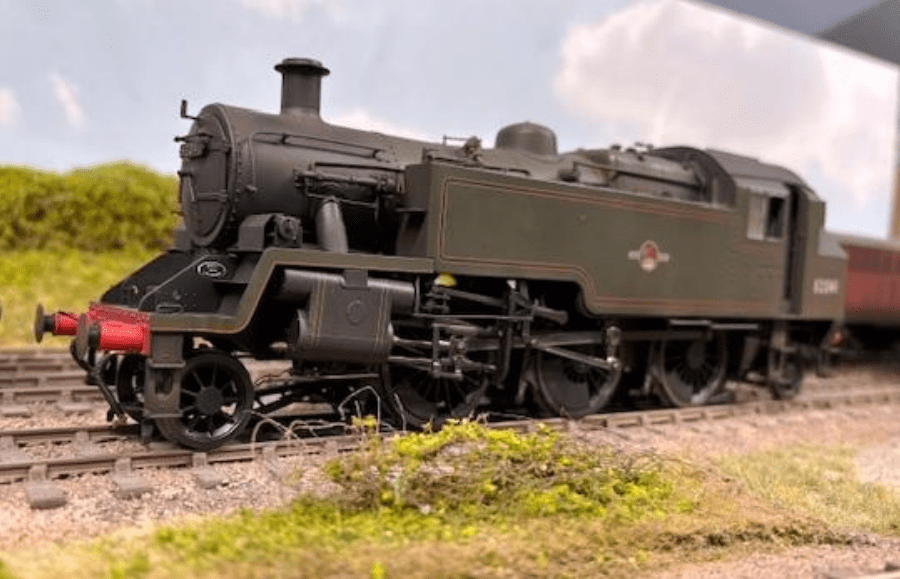
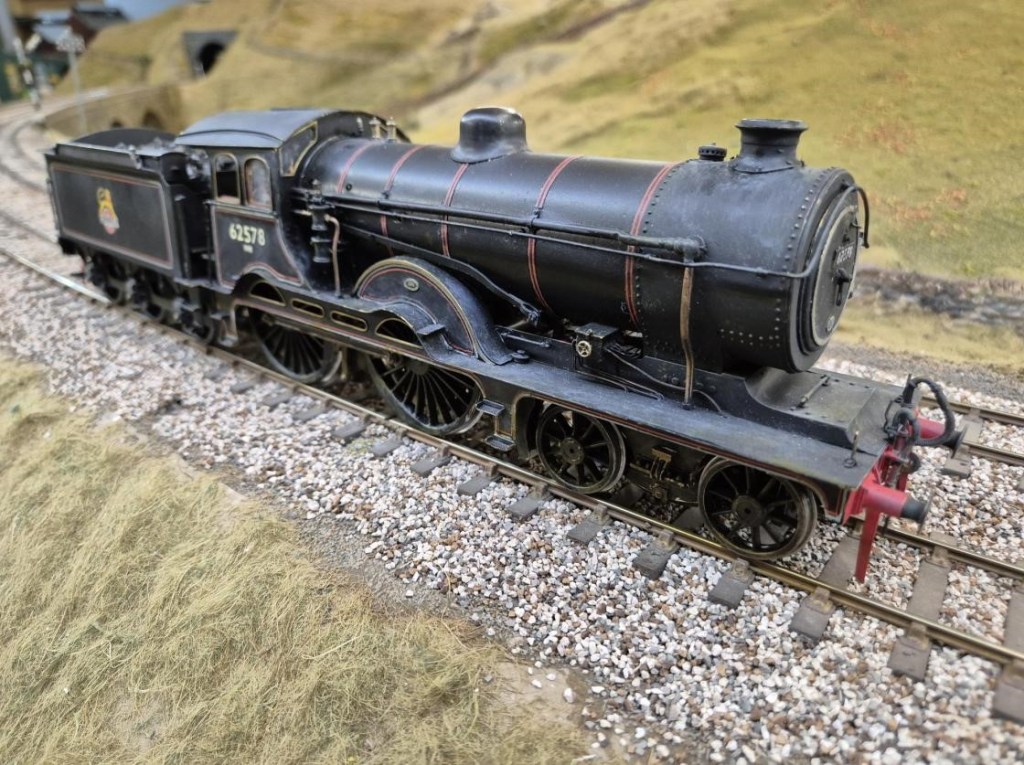
Also from Simon K, a picture of 82041 which was shedded at Bath GP so appropriate for S&D, but it and sister engines also ran on ex GW branches (such as that through Shepton) so OK for his little layout.

Dave H reports that City of Gloucester is coming along nicely – the picture shows the now running chassis. As designed the kit entombs the wheels and motor forever between the outside frames (a bit of a blind spot in an otherwise very good kit). He’s spent some time and bother making the outside frames detachable so that the wheels can come off for maintenance. It also needs special outside cranks made as the Slaters ones don’t work with GWR engines (the extended axles aren’t long enough). Luckily MOK supply some very good machined steel replacements originally developed for their Armstrong kit. The Slaters wheels are good – they screw onto threaded axles which is quite neat. The extended axles for the outside cranks have tiny squared ends to make sure the quartering is spot on.
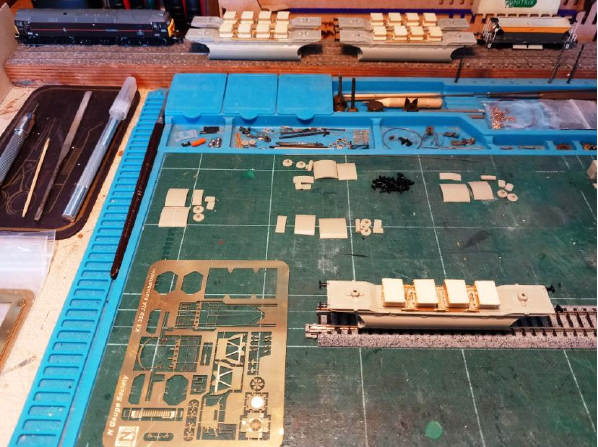
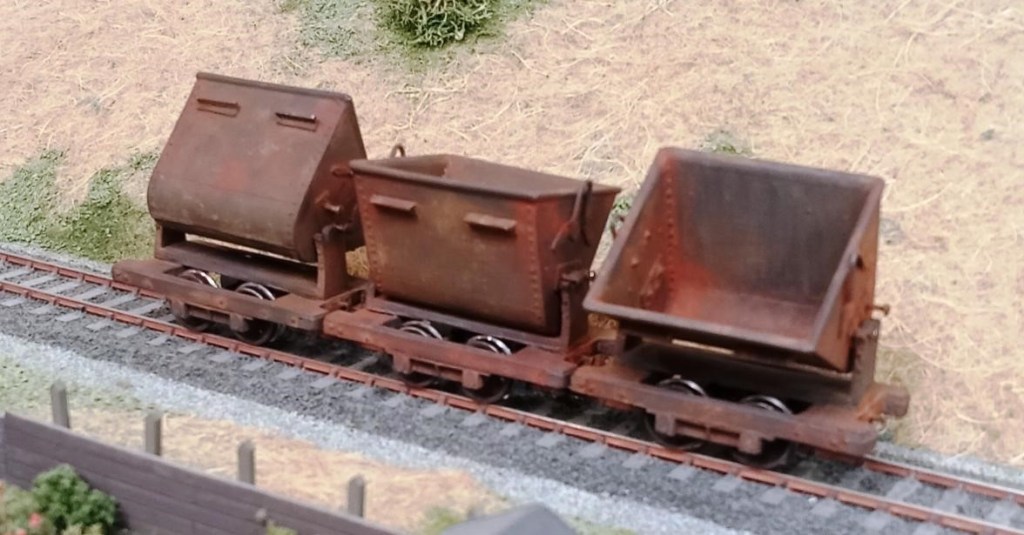
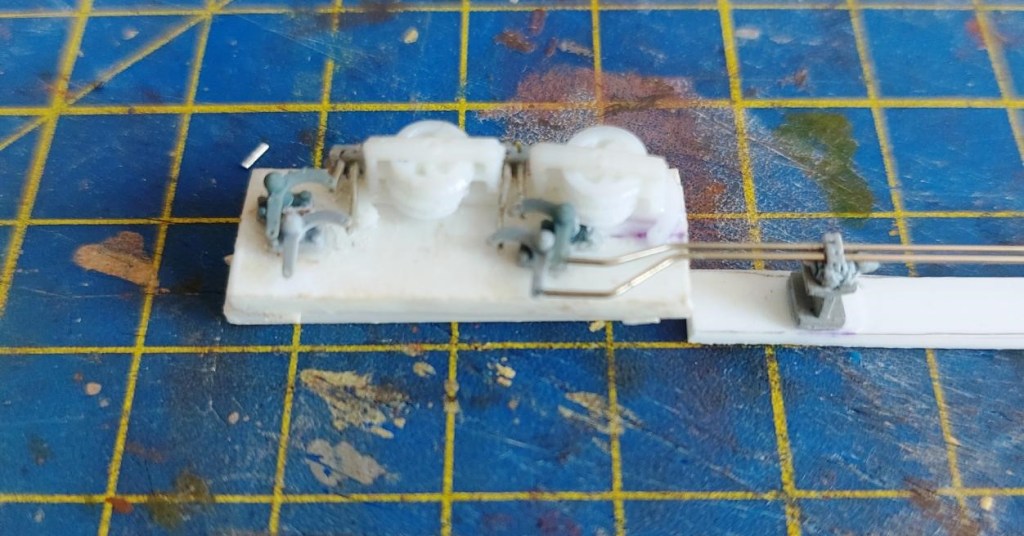
Jim has been working away at constructing a train of 10 autoballaster wagons in 2mm Scale. They are N Gauge Society kits which will have 2mm finescale wheels installed at the last stage – not a straight-forward kit with a sheaf of very delicate etches. The first batch of five have brass etches but the second batch, yet to be started, have stainless steel etches so they may be a little more durable. Below is a picture of the prototype:

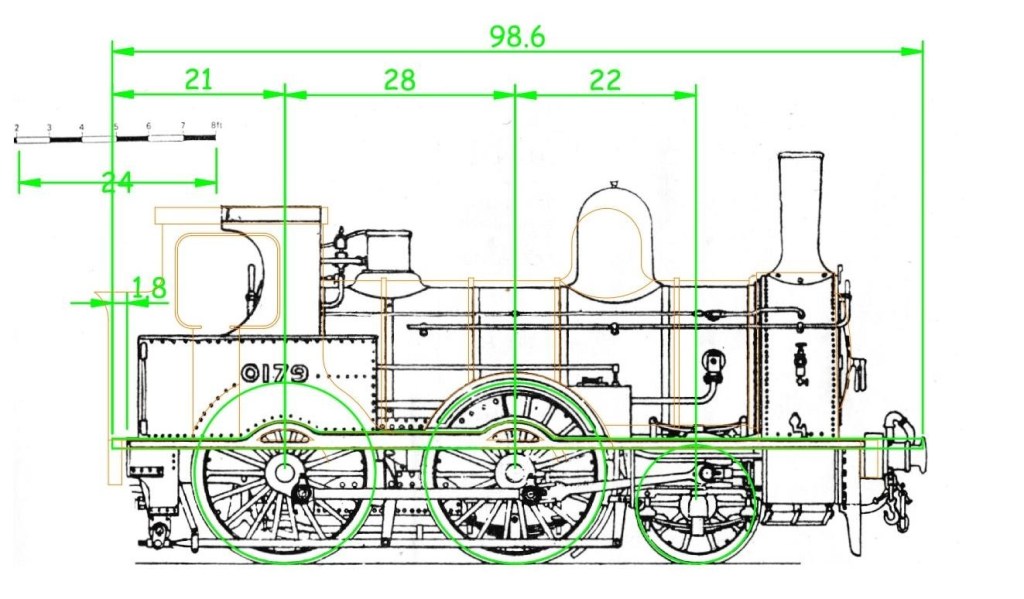
Missing so far from Steve’s putative recreation of the Downton Train Crash of 1884 is the Lion Class pilot engine Stour of 1869. So over the Christmas Holiday options were explored for modelling this Nine Elms built contemporary of the more well known Beyer Peacock built Double Framed Goods. This process turned out to be slippery slope. There were over forty examples of the class, and there are photos of a subset of these engines in Bradley, but none of Stour. The only drawing available was from the Locomotive Magazine from 1933 published in Mike Sharman’s collection of drawings. This is only a side view, but it was scanned, scaled and traced in QCAD and a start was made on developing plan, front and rear elevations from the very few known dimensions.
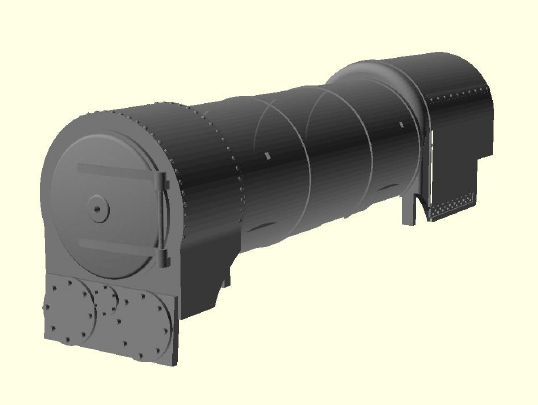
Slithering over the crest of that slippery slope, the boiler unit was modelled in OpenSCAD with a view to 3D printing it. The boiler then needed a backhead, and it needed to be a double firebox one as the Lion Class received the final development of them. The only drawing in Bradley was of 7′ 2-4-0 Clyde of similar vintage, but once traced it was found to fit inside the Lion Class cab like a glove. This is also the backhead that the crude example in the K’s kit was clearly supposed to represent so this will be an upgrade for Vesuvius Class 294.
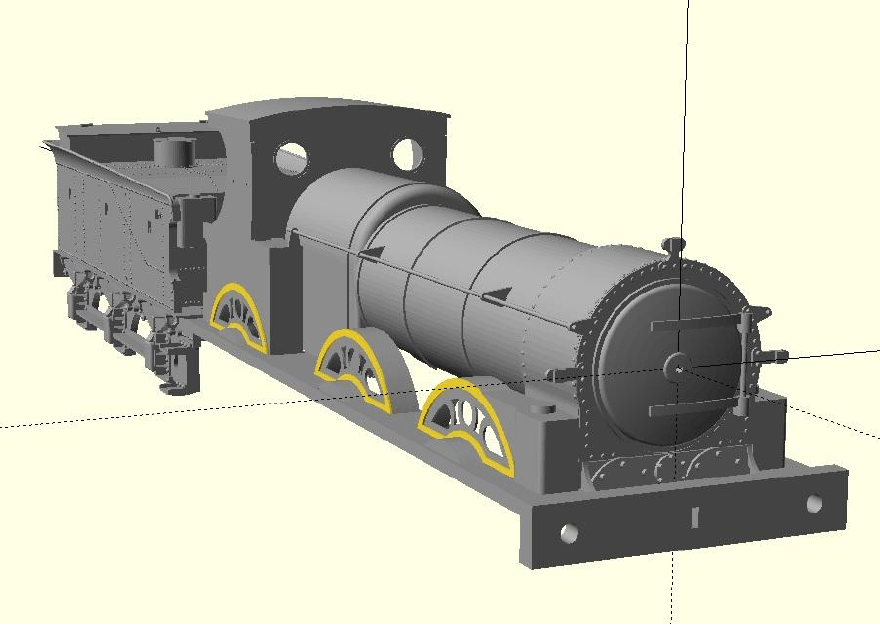
How to make the rest of this somewhat peculiar little loco though? Chemical Etching seemed the way forward for cab, splashers, running plate etc., so the sorts of etched shapes needed were mocked up and a start made on assembling them around the boiler and smokebox unit. This allowed Steve to pose his 3D model against photographs allowing adjustment of the jigsaw puzzle of etched parts to improve the proportions, and confirm fit of the different components. There was now the boiler unit (and backhead), sitting on a reasonable looking running plate with the filigreed splashers and fitted with an Adams’ cab. To robustly model the ‘face’ a half etched smokebox surround was drawn up to also represent the handrail brackets and lamp irons, with the fastenings for those to be pushed through from the back. The smokebox door and hinges, will be 3D printed as will the sandboxes and buffer beam. There’s a gap behind the huge wooden buffer beam on the prototype for access to the cylinder covers, and the cylinder block is clearly angled to align with the crank axle.
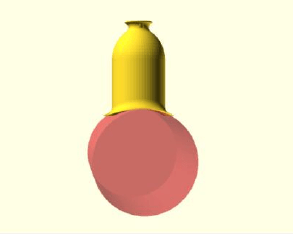
Adams’ stove pipe chimneys are available commercially so not a problem to obtain, but Steve is not aware of any source for those distinctive Beattie domes. As has been mentioned earlier in the thread, OpenSCAD has no tools to flare one cylinder into another, but conceptually rolling a ball round the junction of the two cylinders must just be a matter of some convoluted trigonometry. This needed to be a generic capability so the boiler and dome size and the required flare were all parameterised. Segments of flare were hung round the dome and the correct height of each segment calculated using somewhat rusty trigonometry so that the corner sat at the junction of the two cylinders as shown above. As can be seen this didn’t completely reproduce the ‘ball rolling round the junction’ effect that was required.

Having an engineering background rather than being a mathematician Steve resorted to a more empirical approach to resolve this problem by adding a ‘fudge factor’ (in this case 1.55) for the vertical axis that can be adjusted to further drop the curve of the flare in the correct position for the two cylinders. This left a bit sticking out each side of the ‘saddle’ and this was removed by an intersection operation with an elipse of a ratio of a second fudge factor (in this case 0.95). No doubt a mathematician could come up with a suitable formula for these two crucial values, but that’s something for another day. For Stour and 294 these domes would have been painted, so they will be printed in positon on the boiler, though hollowed out for resin drainage and for weight to be added.
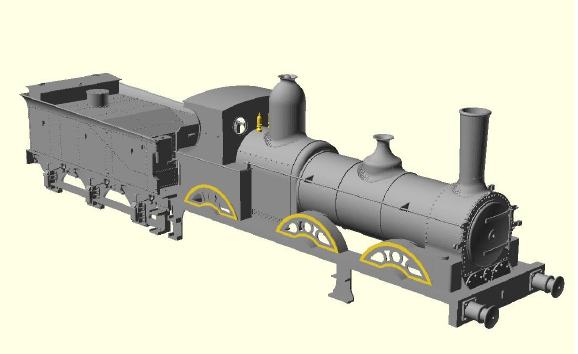
This is the loco attached to the tender. The dragbeam (and running plate) is currently a scale 6’6″ wide and that seems very narrow. The running plate is visibly 6″ narrower than the bufferbeam, that in itself is about the same width as the Beattie tender buffer beam. Photographs confirm that the loco was narrower than its tender but by this much? The Stour of 1884 would have had a sort of pressed steel looking Beattie cab, and the CAD for that will be more cardboard based to try to confirm what an etch for that should look like.

Steve likens his approach to scratchbuilding in CAD rather than commercial kit development allowing a less rigorous approach to be taken to the design. His model will be 4mm scale EM Gauge, but a couple of friends might build ones in 00 and P4 Gauges. The use of 0.4mm sheet for 4mm scale etches might enable models in S or 7mm scales using proportionately thicker etched material with the 3D printed parts scaled up, but his own model of Stour in 4mm scale remains the main objective.
September & October 2024

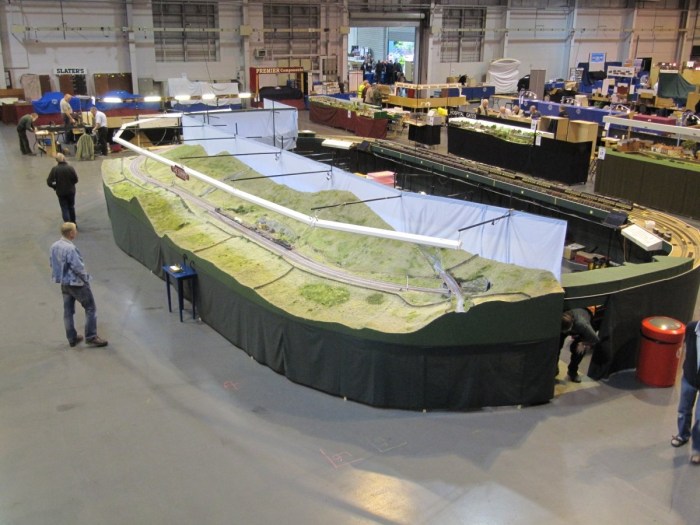
The Summit (pictured below at its first showing in Telford in 2015) will be heading to the Model Rail Scotland Show in Glasgow in February and our focus is now on getting this huge 7mm Scale 0 Gauge layout fully up to speed and ready for a three day show and a lot of miles in a 3.5 Tonne lorry – good job they come with tail lifts nowadays!

The Summit has also been invited to another three day show, the Bristol Model Railway Exhibition at Thornbury at the beginning of May, so some busy days ahead for the team!

Allan has added an ex-GWR small prairie, the preserved 4555 to his fleet of 7mm locomotives. Now fully converted to 7mm, he is advertising the sale of his lovely 4mm 00 Gauge layout “Kingsferry” in the next issue of ‘Railway Modeller’ and is planning an O gauge model of Cole on the S&D to replace it.

Dom has not been idle with his 4mm scale 00 gauge layout Combe Town, and recent progress can be seen above. He’s spent plenty of time building over 2′ of fencing along the front side of the railway (only another 4′ to go!), and has put the initial ground cover down in the field and on the yard surface. For good measure he built one of the Smith’s loading gauges.

    Your editor will spare his blushes as to why, but Dave H’s beautiful scratchbuilt 7mm scale Deeley 990 Class 4-4-0 requires complete replacement. It’s another 4-4-0, but this time it’s a green one – City of Gloucester as built in 1903. It’s based on a Finney kit but heavily modified so it can be dismantled for painting and maintenance, which is tricky for a double framed engine.

    He’s also modified the tender so it will weigh on the rear of the loco. The tender underframe is mostly complete, and he’s made a start on the loco underparts. Dave reports that it’s a good kit and all is going well.

    Continuing the ex-GWR theme, Pete C is finding the conversion of a 4mm scale Rapido model of a 15XX Hawksworth pannier tank to EM Gauge something of a challenge. This conversion is complicated by non-availability of wheels (they’re standard size GW wheels, but with a unique crank throw). The axle size is 2mm and the pickups are an unusual style of plunger pickup which has turned out to be unworkable with a widened back to back. The factory assembly wasn’t the best either, this engine having the same i.e. incorrect not handed coupling rods. The clearances proved just sufficient behind the crosshead by deepening the crankpin hole, which could then be screwed in another 0.5mm.

    The wheels are pressed onto splined axles with top hat bushes which proved insufficiently long to reuse. Delrin rod was obtained and using the Unimat lathe new bushes were made by trial and error – more than enough were made to get ones that fitted accurately. Roughening the new axle ends with a file appears to have been sufficient to stop the wheel slipping on the axle. The original axle face was moulded on the wheel but was cut away allowing the bush to extend the whole way through the wheel and then trimmed.

    New pickups were fitted to the keeper plate using copperclad glued and connected together by 0.35 brass wire on the top surface and reconnected to the circuit board plug through a new hole drilled in the chassis block. New return cranks have been filed from nickel silver sheet and riveted to the motion using Markits rivets. Only the front axle uses the Rapido screwed in crankpins, Romford crankpins have been used as the wheel threads were compatible. New spacers were drilled and turned to size, the return crank will be the final item reassembled after basic testing as they’re soldered on the crankpin.

    As the conversion proceeded more and more parts were removed, it’s a good job an exploded drawing is on the web! The buffers are pretty poor and fitted badly, they’ll be replaced with brass ones. Otherwise the detail is excellent, including in the cab where it can’t be seen!

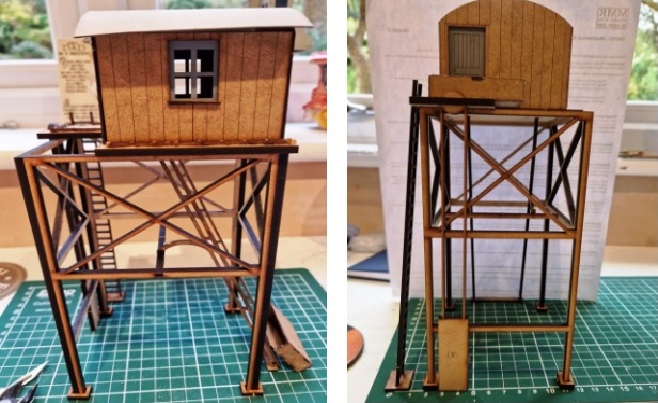
    Derek is a fairly new member to YMRG. Recently he’s had some time on his hands, so he made a start building a kit he bought at Guildex in September. The kit is for an ash plant, and above are two photos of the work so far. He will replace the wooden railings (not shown) with wire ones, paint the model and then fix the roof on. This will eventually be used on a model of an LMS MPD.

    Simon K has acquired this 3D printed shed, coal store and water tower for a little quarry based layout that his wife and some ‘friends’ have decided will be a good project to keep him busy. Most of it will be built by a chap near Ludlow, but he will be doing buildings, people, stock and detailing as it suits him.

    And this is Simon K driving Alice on the Bala Lake Railway.

    Former Chairman Dave S installing the control panel on our 2mm scale N Gauge club layout The Bank with Hon. Secretary and Layout Co-ordinator Dean looking pleased, and Hon. Chairman Ed providing vital moral support.

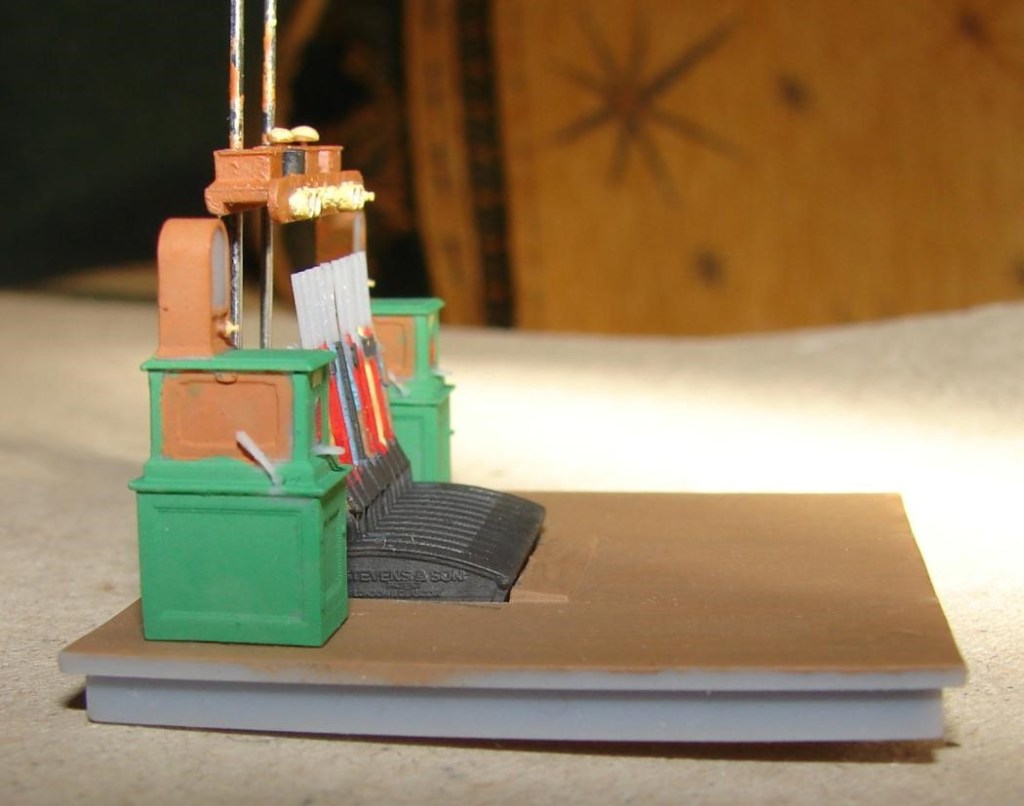
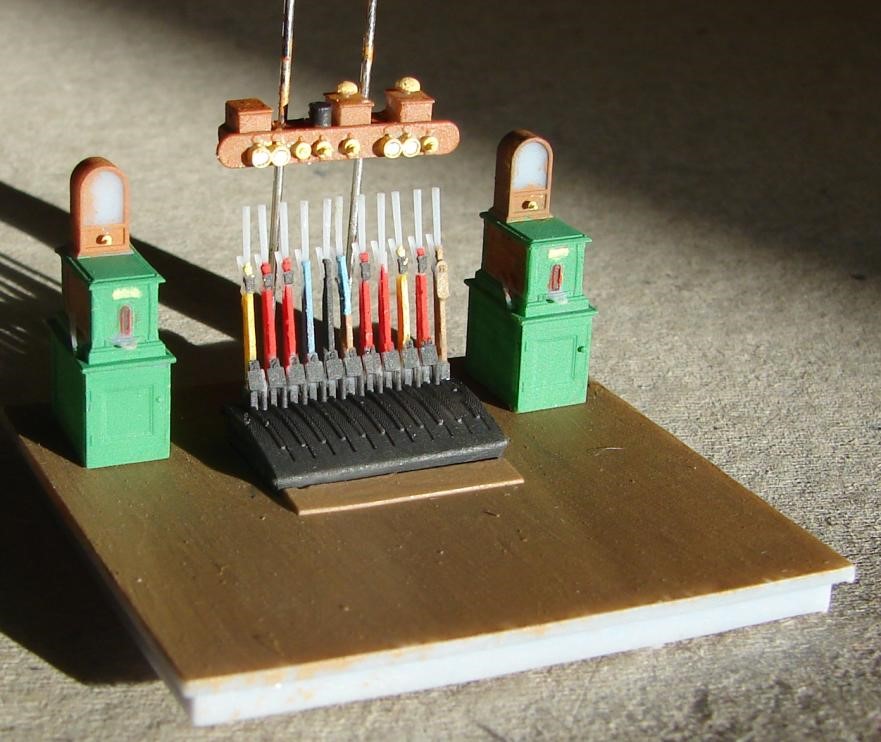
    A couple of pictures from Steve of his 4mm scale 3D printed lever frame, instrument shelf, and Tyer’s No.6 tablet machines as once found at Verwood, cruelly enlarged to show how rubbish his current 000 brush and eyesight are. Any brass has been painted light yellow which seems to work well. It was anticipated that ‘STEVENS & SON’ would be legible after painting, but one can just about make out ‘PATENT’ and ‘LONDON & GLASGOW’ underneath, though the letters are much fatter than they should be due to ‘additive kerf’ – something (that regular readers of the blog will know) makes holes smaller and rods larger in 3D printing.

    The levers are incredibly delicate and a comb like jig had to be devised to hold the levers in place whilst the supports were removed; even then, Lever 6 pinged off where it was nice and thick and has had to be glued back on so is wonkier than the others. There is scope for further straightening with the warmth of a hair drier. This lever frame would even better printed in 7mm scale where the levers wouldn’t need to be quite so plump. the number of levers can be varied and alternative lettering is possible for other makers of Stevens & Sons style frames.

    One of the plunger buttons is missing from the shelf – it probably came off with a support, and no attempt was made to portray the coiled spring for the gong at the left end – a coil of fine wire being the only option. If it had been realised that the handles on the release lever had come out on the tablet machines he’d have picked them out in black, and I would have dotted the labels above the repeaters if I’d been able to see them. He’s left the steel bits of everything unpainted whilst he contemplates what colour steel should be. The steel poles supporting the shelf at 0.62mm are clearly too thick and should be painted green.

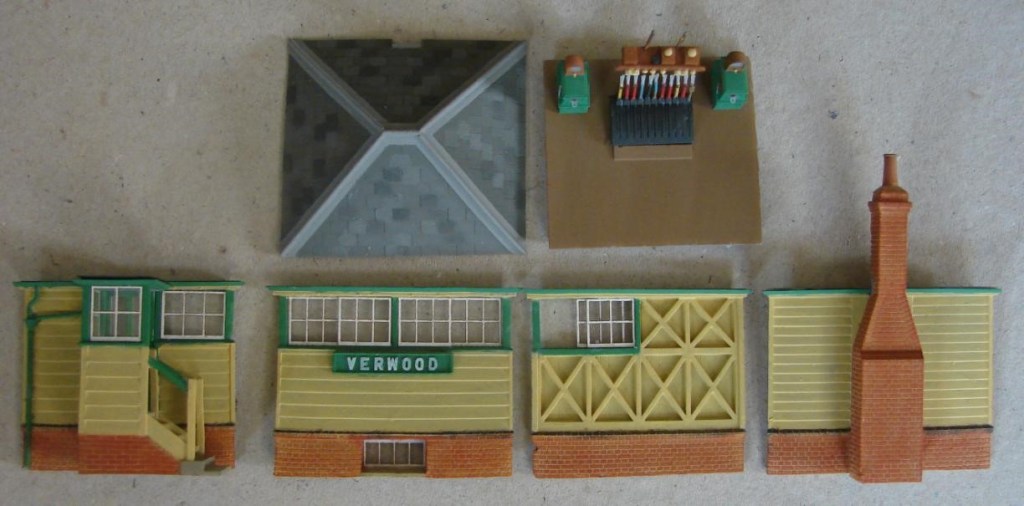
    Next up is the painted parts of the Verwood signal box ready for assembly. There are some mistakes. I failed to order the cupboard with desk, pen and register, and need to pick out the lower string course in dark grey, as well as all but one set of brick quoins.

    This being Verwood there’s no weatherboarding to the wall under the canopy and no drainpipe on the basis that it drained onto the attached canopy. Jurassic Models cut the sash windows for me and they really look the part and fit well. The sashes had to be redrawn to fit the 3D print and then again to allow for the heavier kerf of the laser used. Due to additive kerf the ‘VERWOOD’ lettering on the 3D printed sign is a little too heavy so I’ve redrawn the lettering 0.05mm less all-round and will re-order.

    Now for something completely different – cue Monty Python! When the Beattie Well Tanks were being retired from suburban service in the 1880s, thirty were converted to tender engines using Beattie 1950g tenders – those that have been paying attention to these blogs will have know where this is going! So above is the resulting engine with Adams style cab, overlain with a tracing of the Eastleigh Weight Diagram for a Beattie Well Tank in orange. The tender engines were shorter at the front (not having been rebuilt with frame extensions and steel buffer beam), and have pierced splashers, shielded safety valves, different dome and chimney, but otherwise compare well. The green lines are the Kernow running plate and splashers. The intention is that an etch will be designed to replace the cab unit on the Kernow Beattie Well Tank, and to further this, the necessary parts have been drawn up and will be test built in tinplate by a fellow enthusiast for railway engines of the 1880s.

    Lastly from Steve the three stone pier caps for Pecking Mill Viaduct (see above). A styrene armature forms the arrises and Milliput was used for the lumpy bits. The many brick pier caps needed will be 3D Printed, and the long runs of brick capping for the parapet will be laser cut and etched.

    Jim’s LGP (Last Great Project) tentatively titled Bungham Road, will be a 2mm finescale rendition of Littleton Exchange Sidings at Penkridge in Staffordshire, set during the mid 1990s. This is a photo of the prototype, taken by David Rostance from Wolverhampton in 1985. The new layout will be housed in the space vacated by Halsdon Road after its move north.

    A picture of the superb second hand fiddle yard boards that Jim has sourced for this project, when they were briefly erected in CS2 back in 2019. Rumour has it that Jim already has more than enough stock to fill all those sidings!

    August 2024

    August saw another excellent Railwells show. This year YMRG was represented by Susan’s S4 layout Buntingham.

    Based very loosely on Buntingford in Hertfordshire, it was built in the 1970s by Susan’s father Ray Hammond, a founder member of both the P4 and Scalefour Societies. In this photo Susan can be seen doing something very important in the fiddleyard, whilst fellow operators Dave H (nearest) and Steve both in YMRG shirts are wondering which knob to turn, or lever to pull or push next. Two very enjoyable days, and the layout was well received.

    Regular readers may recall a recent feature on a 3D printed obscure ex-LMS Armstrong Whitworth diesel loco which Steve designed and constructed in EM. This is the mk2 3D print (and nearly finished product with the flush glazing sticking out of most of the glazing pockets) plonked on the track at Buntingham. Looking at that bend in the bonnet highlights how 3D printed resin whilst brittle is also oddly flexible when you’d really rather it wasn’t!

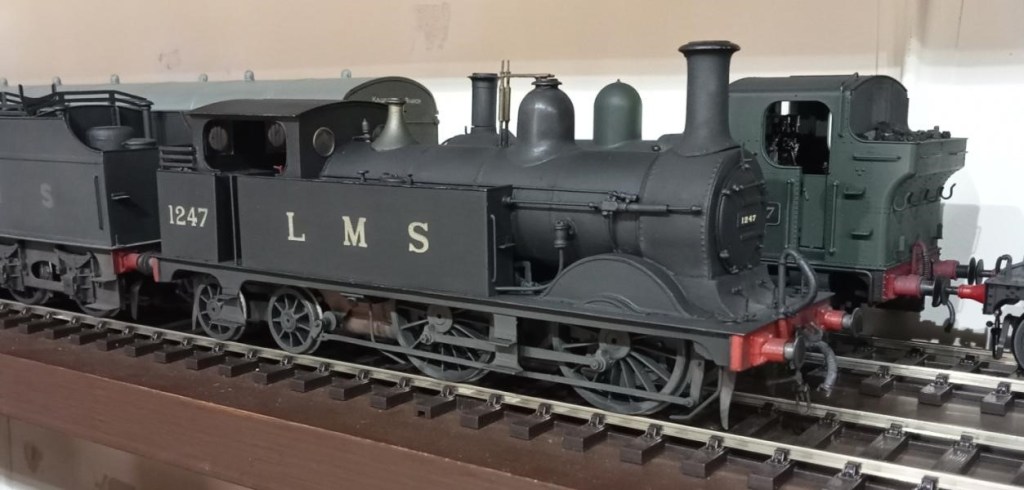
    Allan has finished constructing his LMS Johnson 1P 0-4-4T from a Slaters’ kit – and excellent it looks too:

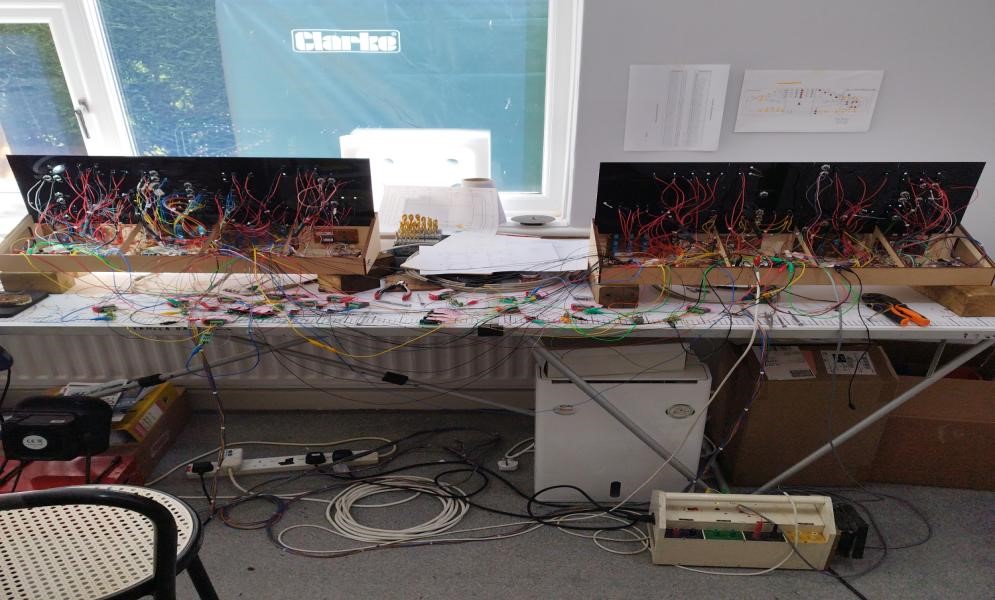
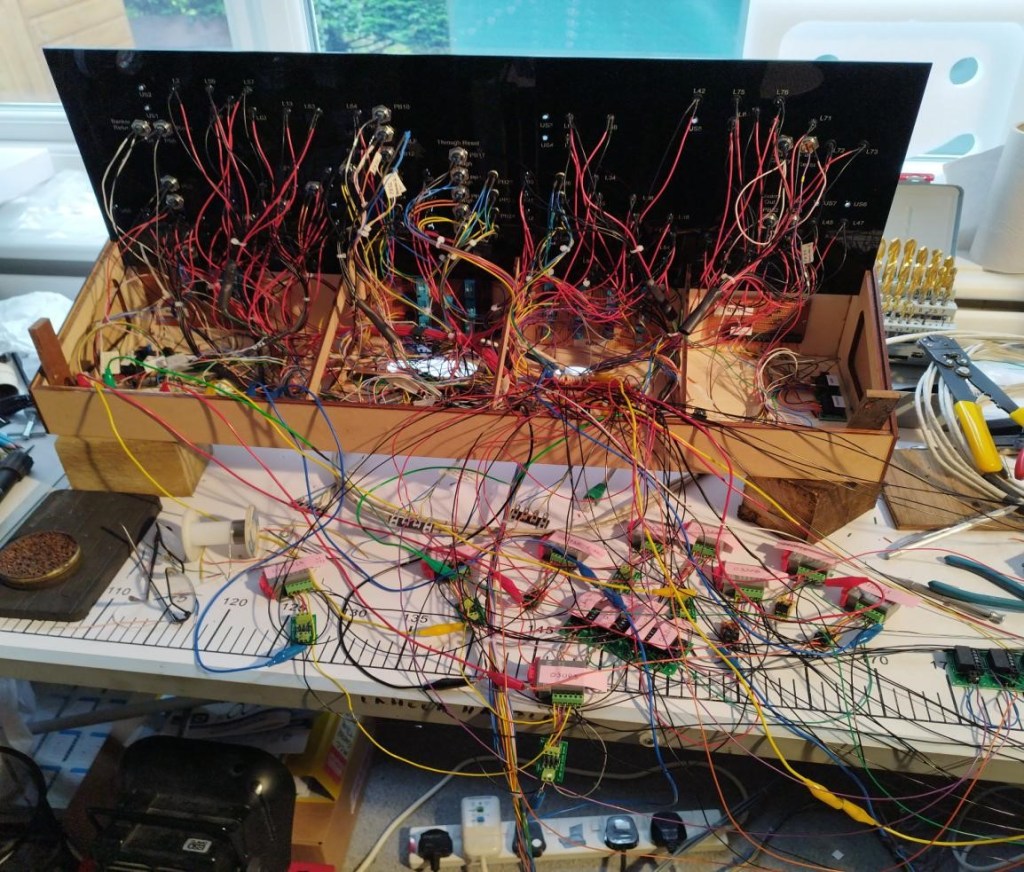
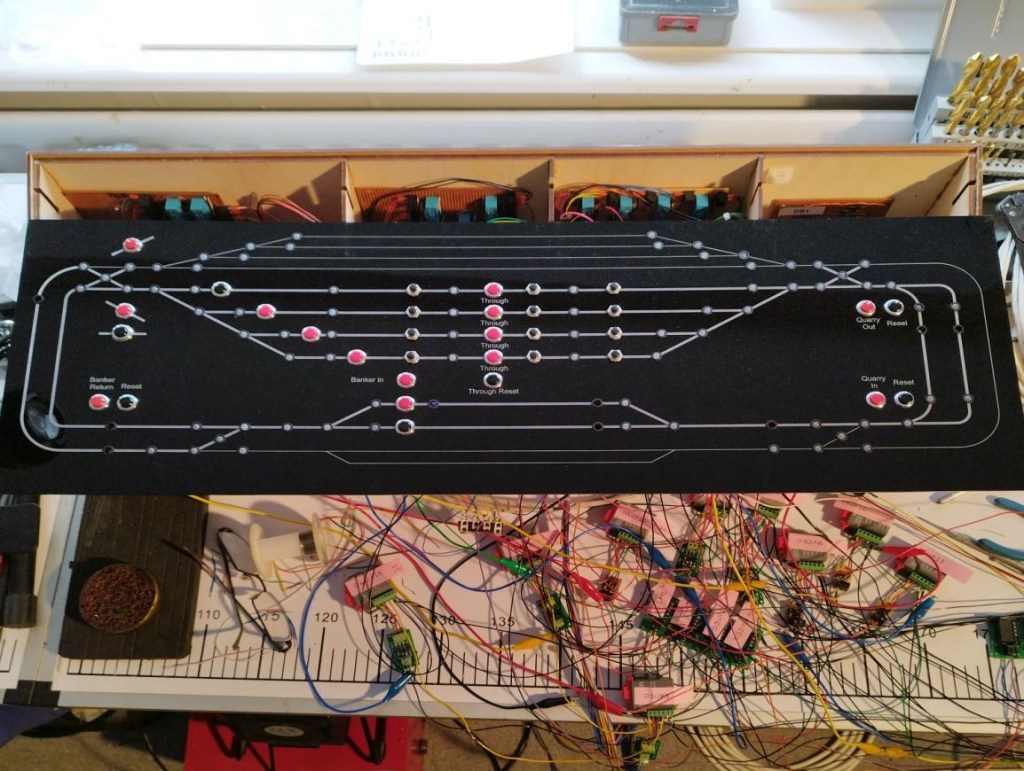
    Our former Chairman Dave S has been wiring the control panel for The Bank (TB), the club’s N gauge layout based on Hemerdon Bank in South Devon. These are nearly finished and he will be bringing them down to CS2 soon.

    The power supply for TB. It provides power for the controllers, the LEDs, the relays and the point motors. It has a couple of spare outputs, 12v DC and 16v AC.

    The bare panel top prior to the addition of switches etc.

    The underneath of the bare panel. Note that all the push button and LED positions are marked for ease of finding them for wiring.

    The finished panels in testing mode with a rats nest of wires connecting the panels to point motors etc to simulate the layout.

    A closer picture of the Up panel. Note the MP1 point motors in the foreground.

    The finished top of the Up panel. It will fit the box underneath when installed on TB.

    Steve will be building his K’s Falcon Class as Vesuvius Class engine 294 – the train engine for the Downton Crash Train. One problem with the K’s kit (the relevant bits of someone else’s complete kit shown above), is that the rudimentary chassis is about 1.5mm too far forward in the whitemetal body, cunningly disguised by making the front about 1.5mm too long. The rear splasher is the correct length, but the coupling rod splasher moulded into it is 1.5mm too far forward, so needs a cut and shut to move it. It took ages to spot this error as the coupled wheel base is also correct, and it wasn’t until it was realised that the sandbox covered far too much of the inner front springs that the error was finally spottted. The aim here is that everything will end up in roughly the right place, as that’s more likely to look right. The changes to the splasher unit don’t stop there, as the front driving wheel splashers on 294 weren’t pierced, didn’t have any sort of trim round them and the coupling rod splasher swept down to the running plate without that step. Between the splashers where the Falcon had an exposed donkey pump, the Vesuvius Class had one that was all boxed in to match the rear splasher.

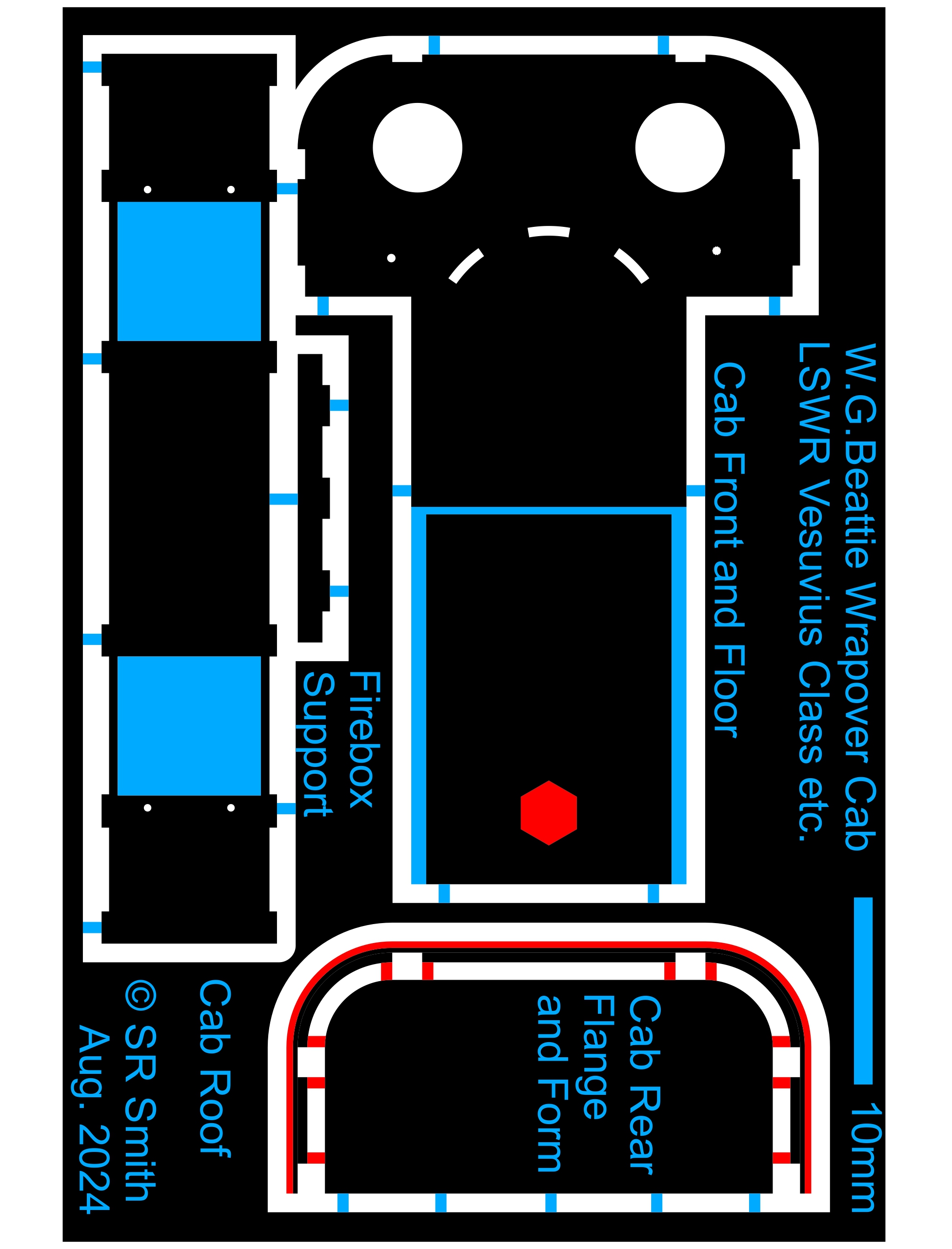
    Below is the home made artwork for all the etched parts that Steve thinks is needed to make a Vesuvius Class body from a Falcon Class kit. All done in QCAD, it was a steep learning curve to work out a method to allow for cusp, and put in moats and tabs in a way that was fully reworkable. Black is no etch, blue is half etch from front, red is half etch from rear, The phototool is a one off, up-front cost, enabling about five copies, It was thought that a modular approach was the way to go, but with the minimum order being a 290mm x 135mm sheet, these two plus the three larger etches to build the engine and tender chassis, almost fill a sheet to make one big etch. This means that any revisions from the test build will require a completely new phototool.

    294 had the flat top Stirling style cab, and being EM Steve can spread the rear splashers a bit so has provided a wider etched floor. The rear driven axle is very close to the cast floor, and to provide clearance for the twin compensation beams he will narrow the K’s casting under the cab. The etched floor with soldered nut provides a better fixing and permits this approach.

    The boiler was raised about 3″ compared with a Falcon, so a more accurate smokebox front with a sort of saddle to lift the smokebox and better simulate the exposed front frames seemed the way to go. On the prototype the buffers are bolted to the frames and the toggled extensions on the cosmetic frames will accept the K’s buffer beam as part of the body – this is much more convenient for a model. The new front allows the smokebox to be shortened (no visible rivets on the smokebox sides), and this also allows the other ways in which the front was too long to be addressed.

    July 2024

    Congratulations to Simon K on an excellent article in the August issue of “Railway Modeller” (published in July), featuring his S&D garden layout as “Layout of the Month”!

    Allan has been productive on a number of fronts:

    He has completed these lovely 7mm scale narrow guage lime tipplers for Evercreech New from Smallbrook kits.

    This beautifully weathered 7mm scale goods shed is for a layout of Lyme Regis for David S.

    The 7mm LMS brake van was built from a Slaters kit and Allan modelled the interior – crazy as it’ll never be seen? Nope, (editor) ‘cos we know it’s there!

    This 7mm loco is Allan’s latest attempt – and possibly his last – at building a loco! It is a Slaters Johnson 1P 0-4-4 tank engine, now nearly ready for the paint shop. There were so many problems building this kit, not helped by the wrong gearbox and motor, the wrong hornblocks, the wrong instructions, then the wrong gearbox and motor replacement! Eventually David S gave Allan one of his – an ABC gearbox and – lo! – it was the right fit.

    Allan then went onto report his acquisition of a scratchbuild LMS 2P to help satisfy his thirst for engines that ran on the S&D. Jim (an enthusiastic proponent of the ‘Senile Scale’ who also models in 2mm finescale) reckons Allan has been so badly bitten by the 7mm bug that he should consider selling his excellent 4mm 00 gauge layout Kingsferry.

    Dave H has produced this wagon in 7mm scale 0 Gauge. It’s a bog standard Slaters PO wagon lettered using POWSides transfers, but at least of local interest! There have been commercial models released of this wagon in very lurid reds, but Dave mixed a guess at ‘London Red’ which was a crimson lake brightened up with some Post Office red, which seems more likely for the 1900s. A bit of light weathering and there’s a wagon likely to have been seen in most of Somerset before the Great War. The transfers took a year to arrive!

    May & June 2024

    In June St. Martin’s Wharf” returned from a very successful appearance at the Shepton Mallet Show, where it won a trophy for the best scenic feature.

    All credit to Bob Alderman who created the layout – and to the members who renovated it!

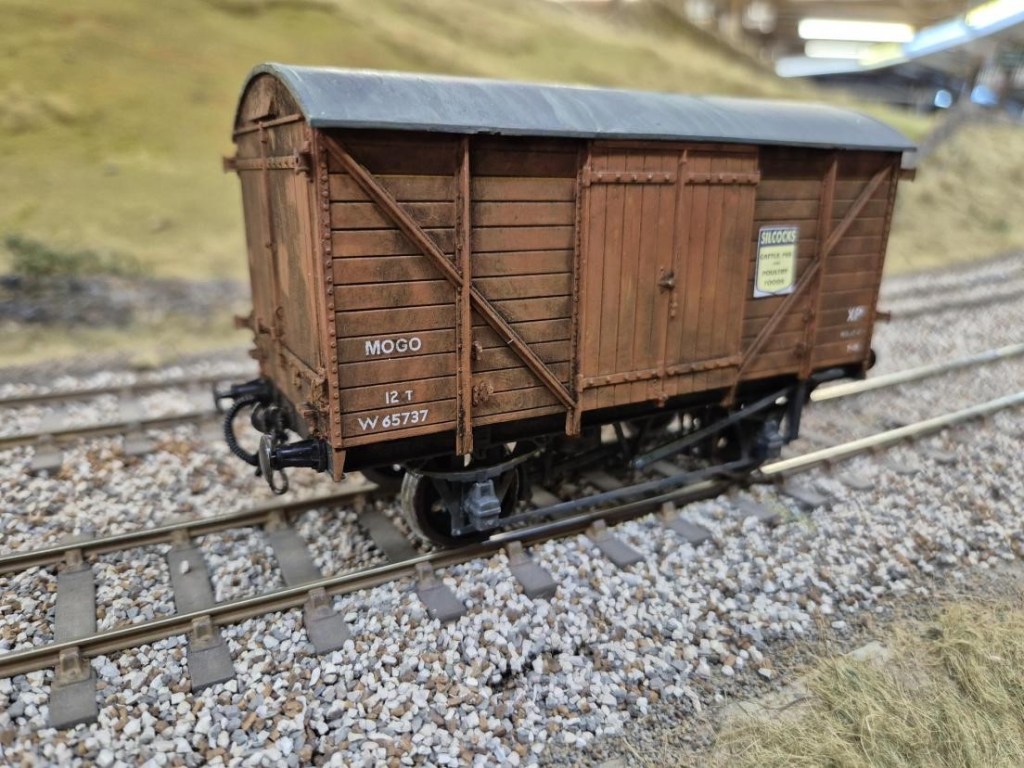
    At our annual competition the Chairman’s Cup was won by a 7mm modeller. Well done Keith S, for his ex-GWR MOGO.

    The Ernie Phelps Cup for Locomotives was won by John M for his 7mm scale LNER D16/3

    The Brian Draper Memorial Cup for Rolling Stock was won by Dave Haines for his 7mm scale GWR Dia E57 Lav Tricomposite Coach

    Highly commended – Pete’s 4mm scale EM Gauge SR 15T Brake van and Trestrol, and the Coker Cup for Railway Related Items went to Keith B for his hand built points on Heyno Junction.

    Dominic has made plenty of progress on Coombe Town. Firstly the station showing the signal box with its glazing and the platform buildings. The headshunt is now ballasted, and he has completed the majority of the sculptamold landforms. The signal box has also received its final large windows today – the next final major exterior piece will be the porch. He is now happy with the general approach to take for Heyno Junction box so will make a start on the actual model there once the size is confirmed with Keith.

    The second is an overall view of the layout, to give an idea of the progress to date.

    There has been much debate around the lime works at the rear of the station and Allan has taken it upon himself to organise the narrow gauge quarry wagons for the works. After much deliberation, he has ordered the above tippler wagon from Smallbrook Studio.

    This is a photo of the lime works that Allan took when the layout was still in Julian Birley’s ownership. Some ‘bright spark’ had the idea of placing Prestleigh Viaduct just to the right of the road bridge necessitating some adjustment to the position of quarry and lime kilns to make it all fit again.

    April 2024

    This month some ‘proper’ modelling, followed by ‘virtual’ modelling.

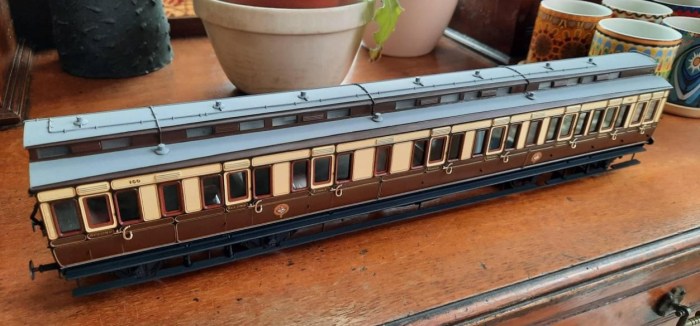
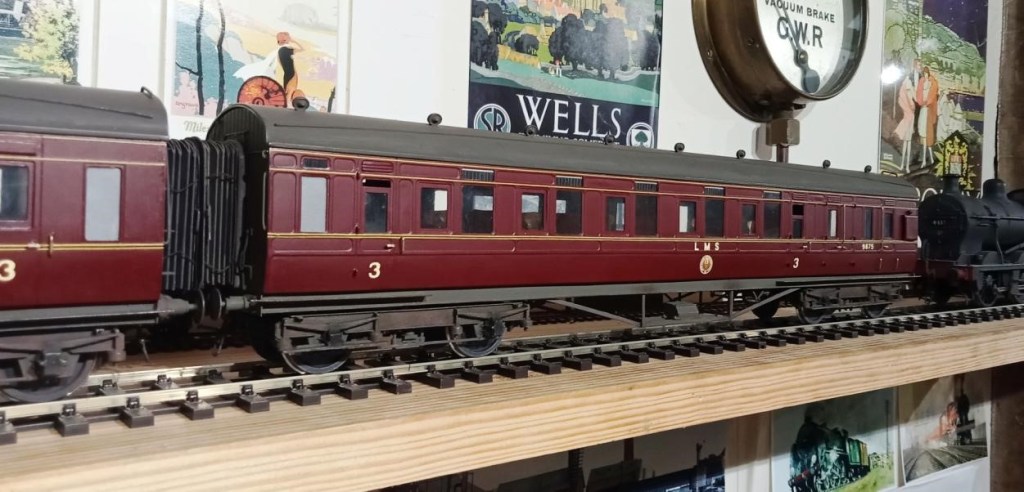
    Allan has finished another of his 7mm scale LMS coaches, this lovely example, from the single window with square corners would be a period II corridor third – from another Sidelines kit.

    Obviously relishing the challenge of turn-of-the-last-century intricate livery paintwork, Dave Haines has produced the next 7mm scale coach for his “Wellsy” layout. This one is a 58 ft long luggage tricomposite, originally built in 1899 for the Birkenhead to Folkestone/Deal through trains run with the SER. They turned out to be very useful as through carriages all over the system so they built twenty of them in the end. They had six lavatories so it’s surprising there was any room left for passengers let alone their luggage! It’s all plastic except for the Slaters bogies (the long wheelbase version that Dean used for his later coaches) and a few fittings, scratch built using David Jenkinson methods and painted using Ian Rathbone methods.

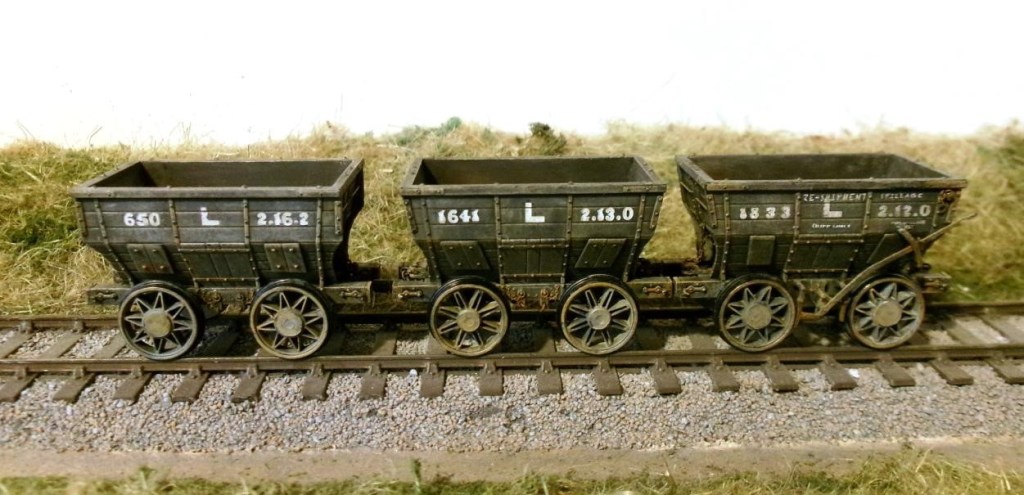
    A few evenings work by Peter has dramatically improved the 4mm scale EM Gauge Accurascale Chaldrons that he bought a while ago. Subtle weathering has bought the detail out from the original plain black satin finish.

    Over the last month Andrew has been working on the flyover bridge for Heyno Junction, the club’s OO gauge layout. It is based on the Aynho Flyover on the Chiltern line. The model has been produced in Fusion360 CAD software and he has started to print out the brick base on his 3D printer. It has been really tricky to do the brickwork as the process makes the computer struggle with long waits while the computer worked out the pattern (he could do with a more powerful computer). The first section took over 20hrs to print out and the 2nd section took over 17hrs. He has started to build up the metal work of the bridge into sections so they can be printed out and assembled

    Whilst at CS2 Steve gave his 3D printed AW diseasel disaster a run out on South Junction, which it plodded around for about an hour without managing to fall off. This was after its trip to Martin Finney’s
    Semley where this model to EM Gauge serenely clambered over and through two sets of P4 points in both directions without derailing. During this feat it was noticed that after 18 years the original tyreless AG gearwheel had cracked and slipped on the jackshaft axle leading to a slight ‘hop’ on each revolution. This gear wheel has now been replaced by its previously redundant twin (on a slightly shortened axle) with the steel rim retained, the spokes covered over, balance weight fitted and the flange filed off. Steve hadn’t appreciated that he needed macro mode on his new to him Sony camera (2011) for it to focus properly for a shot like this that he wouldn’t have previously considered any sort of close up.

    The glazing pockets on the trial 3D print were not satisfactory as I hadn’t made enough allowance for 3D printed items being a little larger than specified – by about 0.1mm and mainly a problem with holes. Thin bubble packaging film could be slid into the side window and door glazing pockets, but not into the front and rear window pockets. To get round this the pockets are now 0.45mm (for .010″ Plastiglaze), and holes have been added above the affected windows to aid resin drainage during printing.

    To aid the printing process a sliver of extra material has been added at the bottom of the body for trimming. The fuel and battery boxes have been boxed in, and braces placed across the base of the bonnet to keep everything aligned during printing and cleaning. This render pre-dates that test run on SJ with the larger gear wheel that has required additional clearance to be added under the gear wheel cover.

    Lastly a helpful Western Thunder user posted a very useful and clear photo of the prototype from a new angle from which detail could be added to the gear cover area (speedo drive cable and oilers). I also used it as a reference to develop some artwork for the WD transfers.

    March 2024

    A very busy month leading with the news that David had reached the point where he could break cover over his new 7mm Scale 0 Gauge layout Lyme Regis.

    The intention was to build this to scale but, large though it still is, it is reduced to 81% of the original. It was always intended to be a project involving others and various modellers are participating in the layout’s construction. Apart from the fiddle yard (next part of the project) the track is laid and wired, most of the buildings constructed and the scenery taking shape. Spoiler – your Future Editor is aware that the flyover bridge at Axminster is on the agenda!

    Lyme Regis does, of course, require three Adams Radial tanks (!) the first of which is making steady progress on David’s work bench. Meanwhile, Lyme Regis is having to make do with slightly over-powered locomotives. The layout is designed to be portable so one day…

    Dom has made good progress on the station building on Coombe Town – the roof is now fully tiled so it’s mainly weathering and detailing to get it to a finished state. The building really adds to the feel of the station as he hopes members will agree from the attached image.

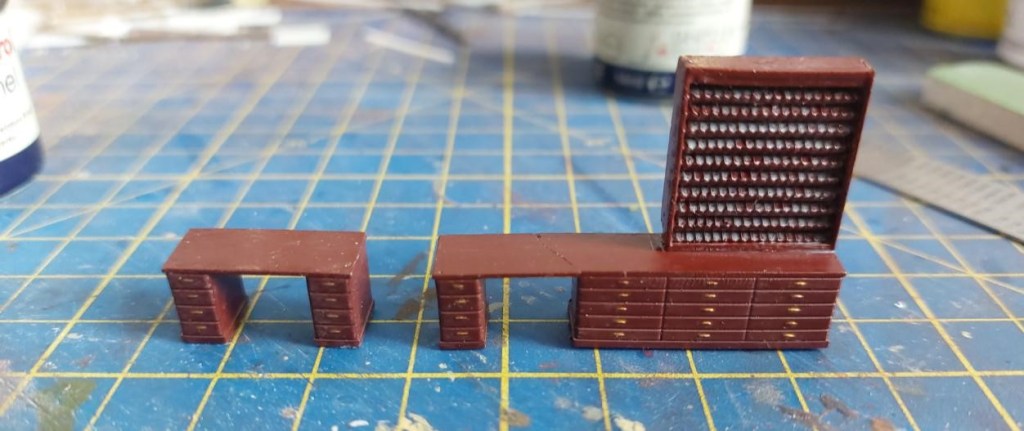
    Dom’s friend was also kind enough to print some office furniture to his design to fill out the offices when he gets to the interior.

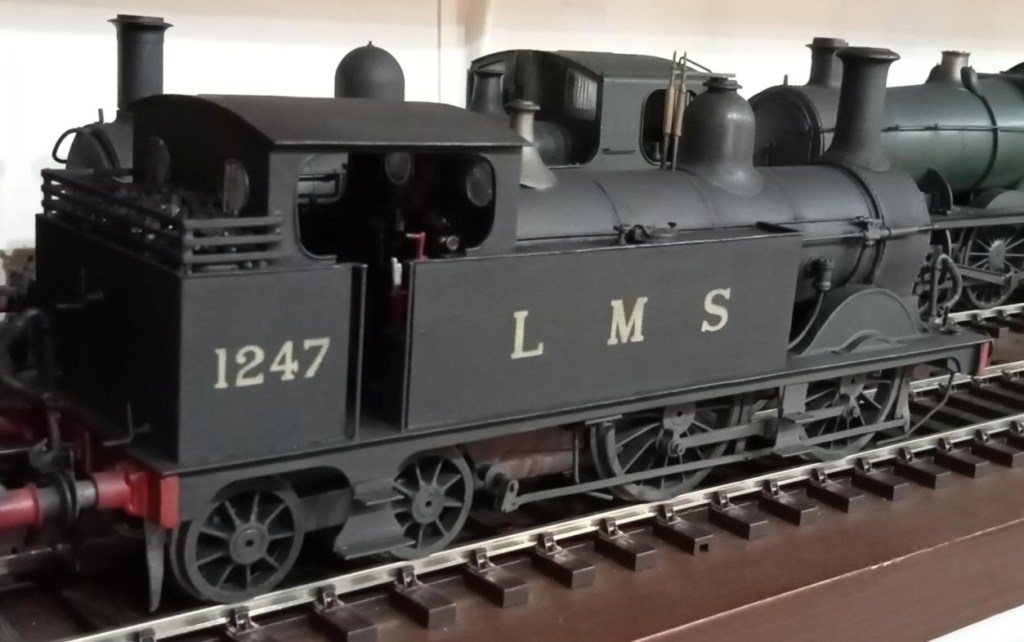
    Allan asked members for methods to remove the BR lion logo from his unnumbered Dapol Jinty. Only Roger came up with a solution, use IPA – not, as Allan originally thought, Pale Ale! Unfortunately it only partly helped, the rest was white spirit and much gentle scraping. he does not recommend doing this. Fortunately the resulting mark – the logo was embedded in the paintwork – was masked with the M of LMS, as you will see from the attached image, now heavily weathered, next to his 4F. The photos below them show 7316 at Radstock in 1950, and 4417 at Glastonbury, and at Cole in 1962.

    This 4mm scale EM gauge Peckett 0-6-0T from a Mercian kit has been built by Adam and was having a running in session on South Junction. It was named ‘The Marshall’ after the late John Marshall who died in 2015. John was responsible for finding both sheds in Martock. He was a Bristolian, hence it being a Peckett.

    Pete’s two Hawksworth auto-coaches have been coupled with the magnets directly into the pockets to give just enough clearance between them, much easier than a bar and loop connector.

    Finally we have enough auto-coaches to run a 4 coach set with the 16XX:

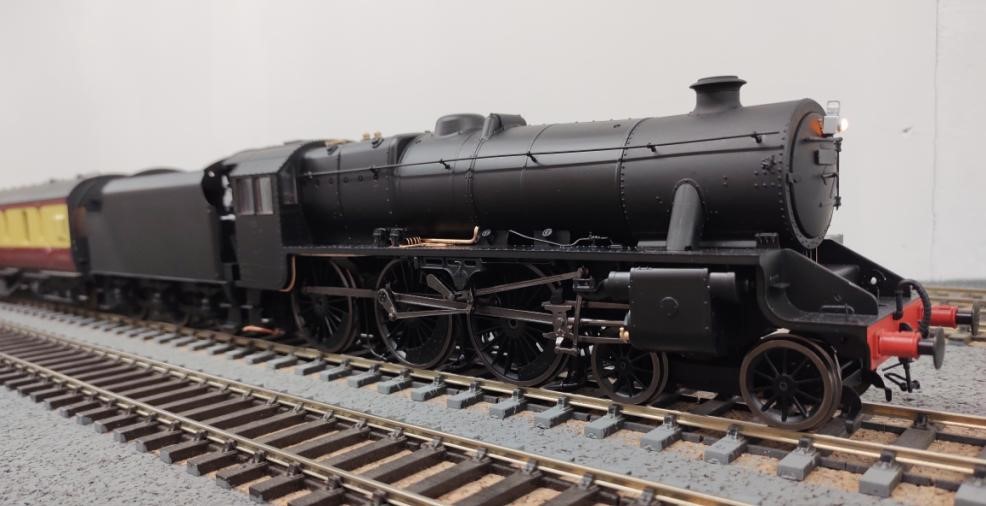
    Dick received his 7mm Ellis Clark Black 5 recently and is very pleased with it. He is still getting his head round all the DCC functions and sounds as he is fairly new to DCC. It can be set up so that the fire needs coal adding regularly, otherwise the engine runs out of steam, but he thinks that is a bit much at the moment. He has yet to add the details and choose a number for it – he is looking for one that worked over the S & D but the Armstrong Whitworth built ones seem a bit rare. 5440 was one but he knows others with that number on their Black Five so is still looking.

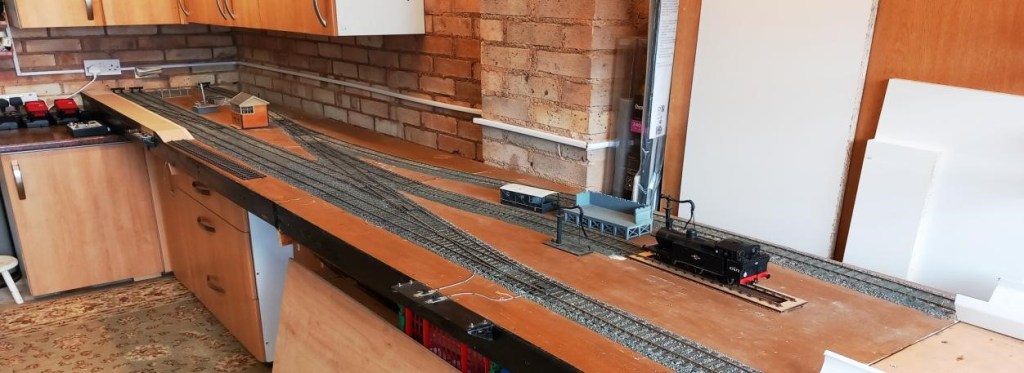
    Plank Street, Jim’s 7mm scale Forest of Dean themed layout started life in Chicken Shed 2, but has now been re-erected in the garage following an enforced stay in the trailer whilst the space was needed for the storage of the new B&Q kitchen. This has now been successfully installed in the kitchen and some of the old kitchen units are now in the garage with the layout below them. The next task is to construct the laser cut engine shed and water tower purchased from ‘L-Cut Creative’ at the Doncaster show earlier last month, so the Panniers and Jinty (below) can have a roof over their heads – not all at once of course!

    And this is the Jinty that Jim couldn’t resist. For sale on the GOG Sales and Wants” site for only £165, DCC and sound fitted.

    Some years ago Steve built a Mercian kit for the ex-LMS Armstrong Whitworth 0-6-0 Diesel Electric shunter that all went into War Department use. Four of them ended up in Belgium and there was an H0 gauge etched brass kit produced to model them, and it seems likely that this ‘4mm scale’ kit was derived from that kit. When built (to 4mm Scale EM Gauge), the loco was found to be 4mm too high and 2mm too wide and towered over any box van it met. Steve had ordered a complete spare chassis etch at the time of purchase, and this allowed him to fully articulate the rods and compensate the chassis on the Sharman principle with one fixed axle. Compensated, with a large Mashima, two 16mm flywheels and a High Level Kits Gearbox and once given enough sideways play on the centre driven axle, it ran exceptionally well. As a result, Steve felt that this was a loco that he couldn’t reasonably give up on, despite not needing it for his model of Verwood.

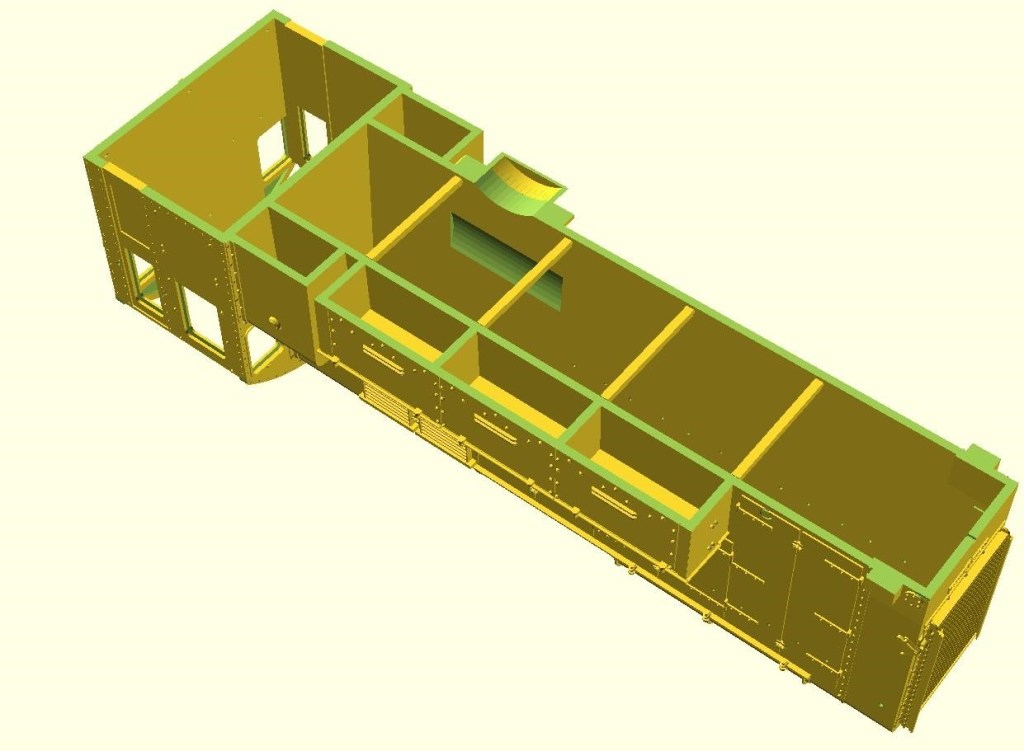
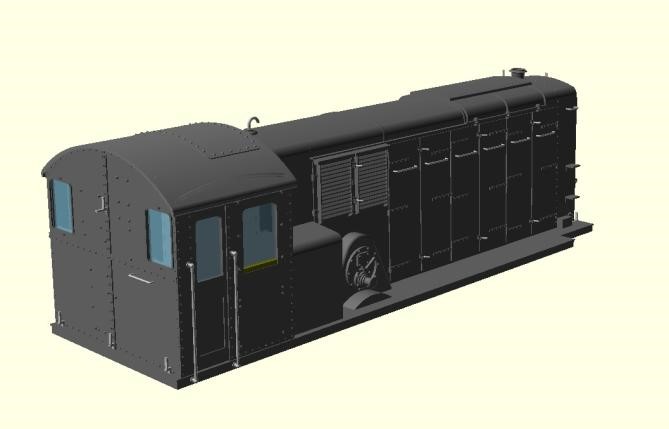
    Having modelled the Downton Train Crash coaches from the 1860s, it occurred to Steve that he should now design a 4mm scale body for it that could be 3D printed, one that would fit on the etched running plate after it was cut and shut. Eight days, 77 QCAD drawings and 1500 lines of OpenSCAD script later he was able to produce these renders.

    The Roche drawing was the starting point, with close examination of photos to winkle out the many errors in the drawing. The etched running plate has been shortened, though not by much. A bit was taken off the edges, with the valances refitted slightly inboard, and now the width is about right. The overall wheelbase is 60mm when it should be 58mm, and that pushes the brake blocks behind the sanding hoppers, which being in their original positions are slightly too far outboard – but then something has to give. On Western Thunder Adam perceptively described it as a ‘rubber ruler job’!

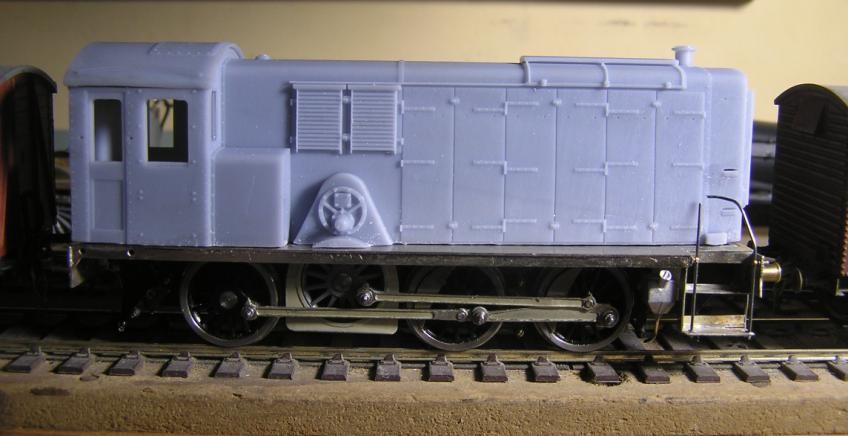
    This masterpiece of the resin 3D printers’ art (by a specialist) is seen perched on the shortened running plate and chassis, with (happily) everything now pretty much where it should be. The glazing pockets for the side windows came out OK, but will only accept packaging film, so they will need to be opened out to allow for the ‘additive kerf’ of 3D printing. The pockets for front and rear cab windows did not form completely as the resin was unable to drain from the deep slots above the windows, so those will need to opened up to the cab so that they will drain. As with the 1860s coaches, flush glazing is a must and adjustments will be made to the model for the mk2 print so that it will accept Plasitiglaze or glass cover slips. There’s nothing that Steve can do to stop it being an ugly brute flush glazed or not!

    January & February 2024

    Still in the throes of modelling season there has been plenty of activity by members of the club.

    Dom has been working on the station building on 4mm scale 00 gauge Coombe Town. A couple of images of progress so far, showing the level of interior detail with fireplace in the booking hall. The back wall window and timetables are still to be added.

    Externally both chimneys (brick and stone) are now complete and the rest of the roof is coming along nicely.

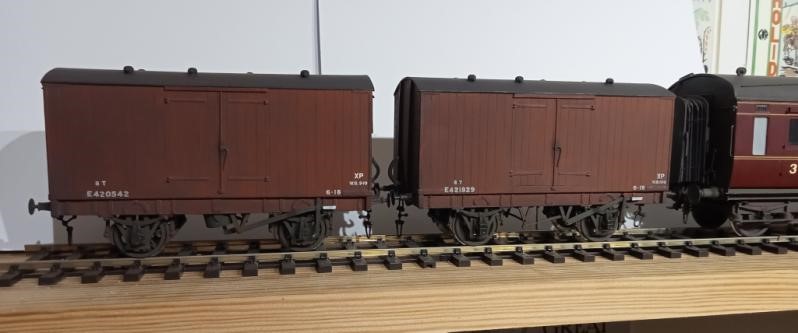
    Allan has been beavering away, stripping and repainting some 7mm wagons that had been donated to the Club. He says: “Members might be interested in the attached pictures of the three wagons and two vans kindly donated to the club courtesy of Roy recently, now repaired, modified, painted and weathered. The ex-GNR fitted vans required amendments to the brake gear as well as some additional detailing before repainting, numbering and weathering.

    The wagons also required some modifications to the brake gear and further detailing. The short-bodied PO wagon, originally a ‘blank canvas’, has been given a new identity, but any research into the Nene Brick Co of Peterborough will be fruitless! The lettering comes from the NE sheet of decals used for the vans – well, bricks were made around Peterborough so it is feasible! Unfortunately this wagon is sparse in detail and ‘rocks’ on the track so perhaps it is best permanently retired to the back of a siding.”

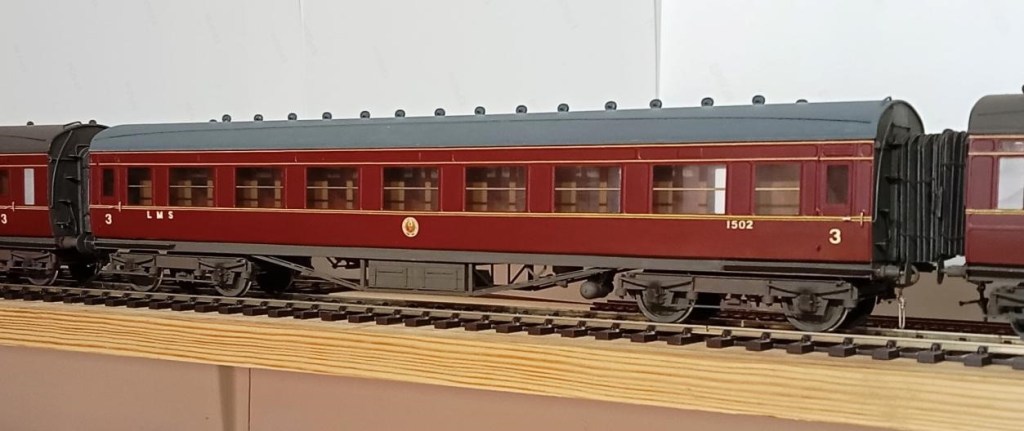
    In addition, this is a rake of LMS vans which Allan has recently finished.

    Steve has been working on a model of Verwood station for as long as anyone can remember, or at least since 1992 when he decided Fordingbridge would be too ambitious. Within the scope of this quest is a selection of trains that ran on the Salisbury & Dorset line.

    A while before Christmas one of those K’s Milestone Falcon Class kits turned up on Ebay with hardly any of the dodgy underpinnings that would have been discarded, so he put a slightly cheeky bid in and ‘won’ the thing. He had thought that the generic Hattons and Hornby coaches would be suitable for it, but on having a proper look at them, they seemed too modern for what he had in mind from the few photos of LSWR trains that he had seen from the 1880s. Then he remembered perhaps the most famous train on the Salisbury & Dorset – the Salisbury to Weymouth service that derailed at Downton in 1884. The BoT Accident Report is available on-line, makes fascinating reading and gives a very good description of that unfortunate train, including coach numbers and types that he could cross reference to the first of Gordon Weddell’s superb books. Of the event, that cost five lives and caused many injuries, there are no photos, just a couple of lurid drawings that are inconsistent with each other and with the plan in the accident report. So, if anyone has wondered what a Salisbury & Dorset train looked like in the 1880s, this could be their day.

    No.DescriptionCompart-mentsLength over Buffers (BoT)Length over BodyBuiltWeddell Page
    167Passenger Guards Van023’8”20’186552
    429Third4~21’2”19’186556
    16Third4~21’2”19’186556
    42First3~21’2”19’186548
    337First3~21’2”19’186248
    22Second4~21’2”21’186251
    43Third4~21’2”19’186556
    99Passenger Guards Van022’10”19’186043

    Made up into a block set in 1883 at Clapham Junction, but at some point 99 had been substituted for 191 and 16 added probably at Salisbury. 167 was the lead vehicle.

    Gordon’s book has drawings and photos of the carriages involved and on Christmas Eve Steve started to use them to 3D model the Third Class coach in OpenSCAD and QCAD as a sort of test to see what was possible. All of the vehicles were modelled in ‘late’ condition as normally photographed, with steps on the ends of each pair of coaches.

    Happy with the result, he tackled 167 the passenger guards van. Although a boxy little thing it did come with a ‘caboose’ and the ‘powerful’ Newell Brake that could also brake adjacent carriages. This led him to model the look of that mechanism too, complete with an attempt to portray the curly spoked control wheel and the many bevel gears involved. He then went back to the Third Class coach and gave it the parts of the Newell brakes that I thought it needed.

    The First (top) and Second Class (bottom) coaches were next as these had much in common, so were more like tackling one coach. They have a very distinctive look that may be more to do with the Metropolitan Carriage and Wagon Works than the LSWR since the Brighton had some almost identical coaches. The assumption is that the Second Class coach was braked, and the First Class coaches weren’t. These short coaches were close coupled in pairs to help to stabilise them, presumably in a similar way to the suburban block sets.

    Bringing up the end of the train was the van that shouldn’t have been there, an externally framed vehicle that has become my personal favourite, whilst we can be certain that all the other vehicles had Mansell wheels, this one it seems had 3’8″ wheels with eight spokes.

    All of these coaches and vans have been designed with glazing pockets built in. They have cosmetic W Irons to support the Newell Brake bars, There should be room for Masokits W Irons (externally or internally sprung), as these short little coaches will definitely benefit from suspension. The interiors are modelled with wooden benches in Third Class through to plush seating in First. It seems that the desk and raised platform in both brakes were enclosed to form ‘dog boxes’. Bill Bedford has advised that these coaches should be 3D printed complete with the underframes and separate roof, but just how feasible this will be with current technology remains to be seen. There is a thread on Western Thunder for this unusual project:
    https://www.westernthunder.co.uk/threads/downton-train-crash-of-1884-in-em-gauge.12490/

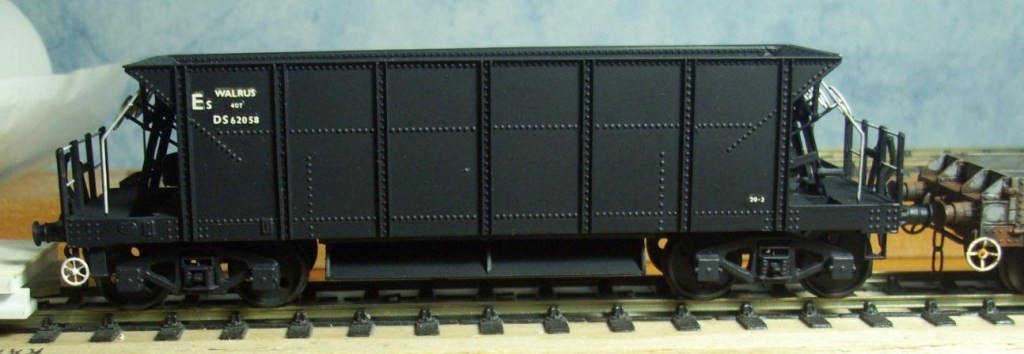
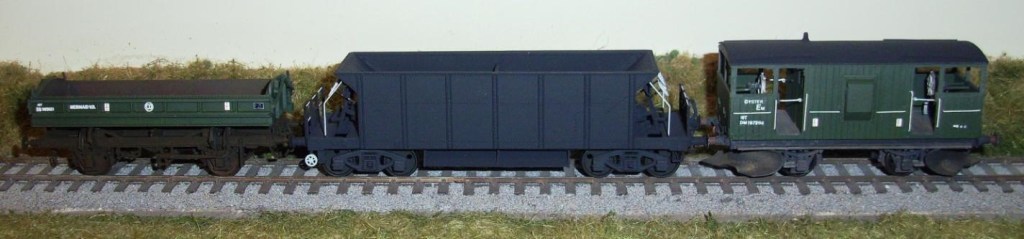
    Bringing up the rear (hopefully with brake van and tail light) Peter has built and/or weathered two impressive engineer’s vehicles in 4mm scale/EM Gauge a Cambrian “Walrus” and an Oxford Rail “Pilchard”.

    November & December 2023

    Allan has been busy working on his rake of LMS coaches and the buildings for David’s new ‘Lyme Regis’ layout in 7mm scale 0 Gauge.

    His completed model of an LMS all panelled ‘two window’ brake third.

    The fibre cement engine shed at Lyme Regis – that green is just as your editor remembers it on railway buildings in East Dorset.

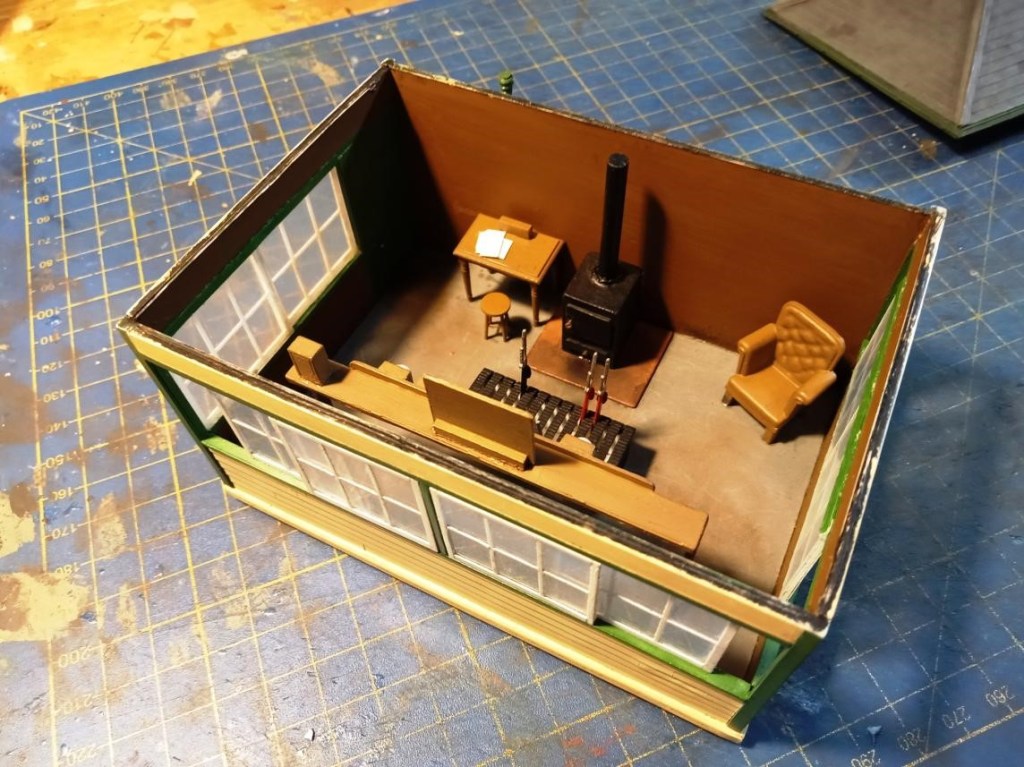
    A lovely model of the signal box with partially open sliding ‘Yorkshire’ sash windows and modelled interior. Your editor doubts if the internal walls were brown, though he could believe the floor was.

    The station building at Lyme was re-erected at Alresford, but as Allan discovered on a site visit, not without some compression. This stunning model is of the station building as it was at Lyme Regis post-war.

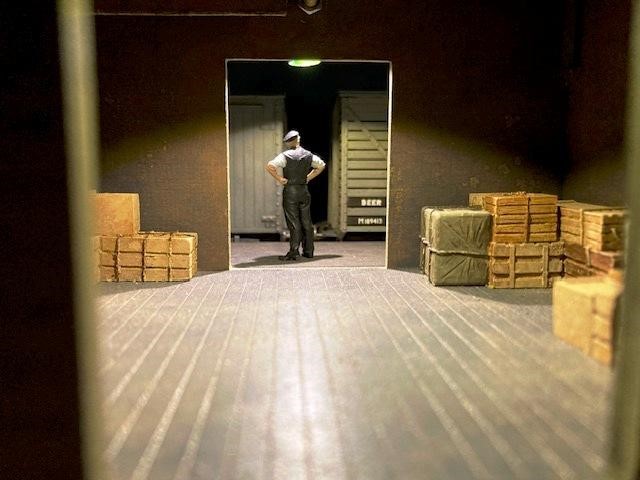
    This evocative cameo is from Simon K’s new 7mm scale O Gauge shunting plank ‘Cerne’. The goods shed foreman is clearly contemplating his next move with the contents of the “Beer” wagon.

    Two other scenes from Cerne showing the beautifully modelled figures.

    Dom. continues work on Coombe Town (4mm scale 00 Gauge) with the station building curently receiving attention.

    October 2023

    Much more going on now we’re back in modelling season. At the start of October Half Term, we had a very successful outing of “St. Martin’s Wharf” at Rail-Ex Taunton; the Somerset Club putting on another excellent show in what must be a unique venue. The school dinners were indeed fantastic, and not like they used to be – well, at least in your editor’s experience anyway!

    Dave H was responsible to organising its appearance at the show and commented afterwards:

    “St. Martin’s Wharf went down very well at Taunton. It looked beautiful and performed well. The switch to DCC meant that it was much more enjoyable to operate than the last time it went out. The main problem we had was invisible muck on the track (which we solved in the end by polishing all the rails with fine emery) and the usual teething problems with AJ couplings. By the end of the show we had a set of stock which coupled and uncoupled reasonably reliably!

    Thanks to everyone who helped to get the layout and stock into an exhibitable state, and to all those who helped with shipping it to Taunton and back, or operating at the show. Once we’d set it up and added all the vehicles, people and other bits and bobs it looked stunning. I believe BRM want to come to photograph it one day, so we better make sure the rats don’t get into it again!”

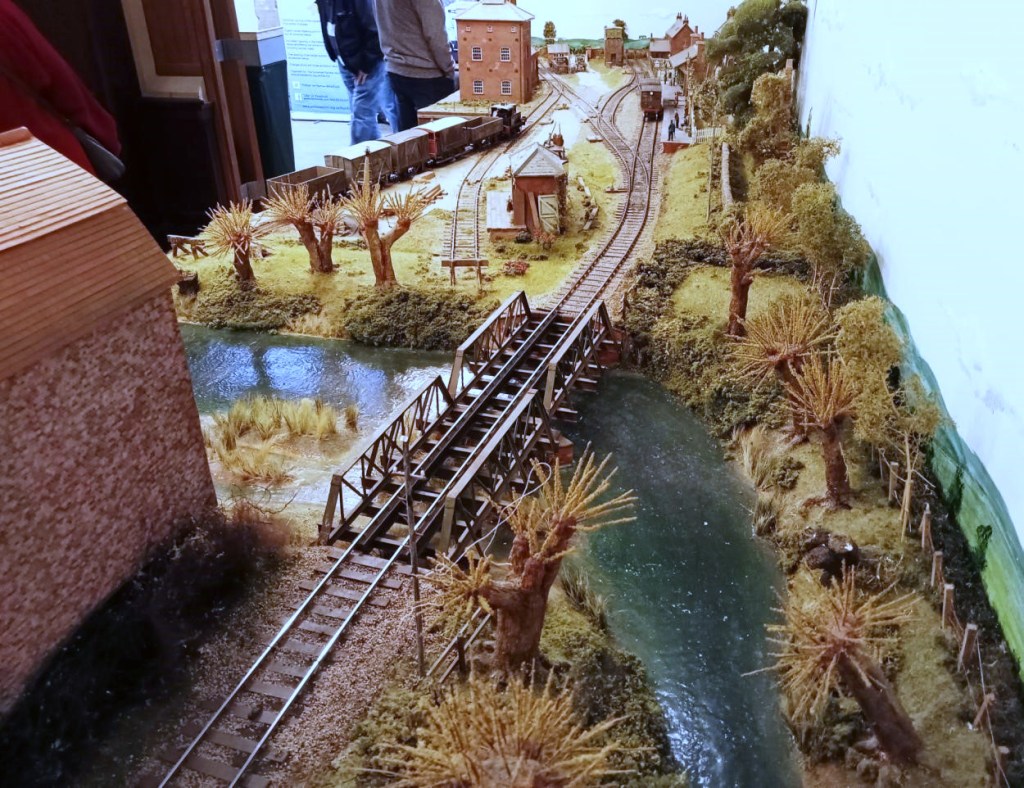
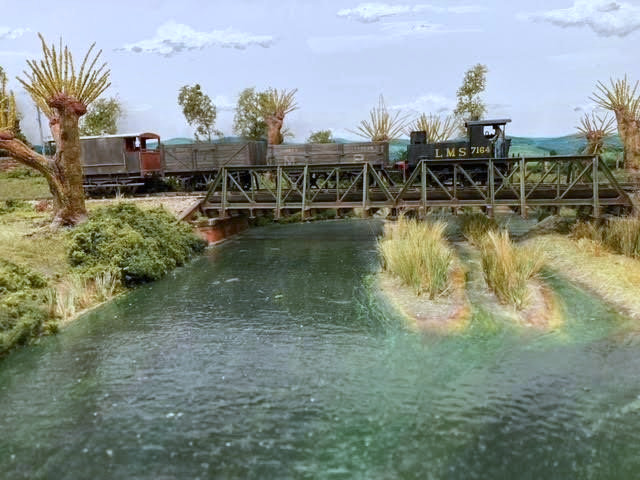
    The fully modelled truss bridge…

    …and with train passing over.

    John has had a major wagon building binge. These are all 7mm scale 0 Gauge wagon kits that have been languishing in a cupboard for many moons, built while taking tea or rain breaks from gardening. This coke hopper is a Parkside kit.

    This ex GWR hybar is from a Coopercraft kit. It is loaded with wagon sheets. About 1960 John went to North Norfolk on his bicycle and visited the remains of Melton Constable Works. Ruination was all around me, except one building where six men in protective clothing were making wagon sheets. The canvas was hung up on a rail and was covered with some evil smelling thick liquid, coat after coat, applied with nothing more advanced than sweeping brooms. The drips were drained into a bucket for further use.

    This Parkgate is a Slaters kit. What a dirty mucky place Parkgate was when John had to pass through it on my way to my office in Sheffield city centre.

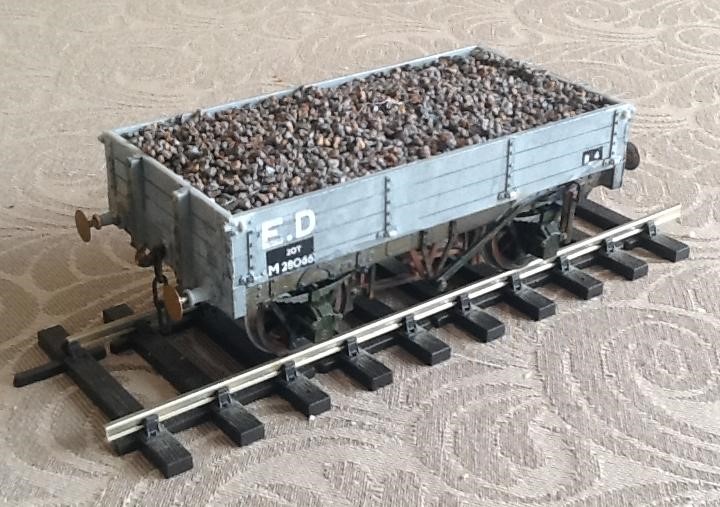
    This ex Midland three plank open now works for the civil engineer. It is loaded with ballast – likely to be from Morris & Perry at Gurney Slade by the look of it. This is another Slaters kit.

    Finally, this SR six plank open is from a Parkside kit. In the late seventies or early eighties John took the train from Axminster to London for a meeting and parked in the sidings east of Salisbury station in this livery. A bit grubby but wearing this attractive brown. It is loaded with sacks.

    Continuing the wagon theme, Pete C has been working on the above in 4mm scale EM Gauge. All are from Cambrian kits. Left to right – Mermaid, SR Walrus waiting lettering and destroying the NATO anti radar black (the black was let down with white), and Oyster modified Shark kit (longer Cabin than a Shark).

    Jim has been continuing the wagon theme, but in 2mm finescale of course. The Whale/Seacow project has slightly ground to a halt due to boredom, so his attention has switched to other “gloat boxes”, otherwise known as box files. In one, he found ten completed plastic bodies from TPM (Bernard Taylor) for JUA bogie aggregate wagons, converted from iron ore tipplers for the Merehead to Acton flows with Foster Yeoman. The kits are now available from the N Gauge Society.

    One already had the 2mm Scale Association replacement bogie kits fitted and there was a note saying “nine more needed”. Duly ordered, they came last week and all ten pairs of bogies are now constructed. They are a nickel silver etch with whitemetal castings attached and take standard 2mm wheels on 12.25mm long axles (rather than N gauge ones around 14.8mm long). On the next page is a picture of the workbench with one completed wagon and the bogies in various states of assembly. The tiny top hat bearings need filing down so the castings can be super-glued to the etches and a little jig to help with this (the T-shaped things on the left hand cutting mat) is included in the etch, as are replacement ladders and handbrake wheels. Is he Mad or what?

    Dom has been constructing the most fantastically detailed 4mm scale point rodding for “Coombe Town” – just needs rust and a little grease…

    This is the latest addition for Simon K’s Cerne ‘shunting plank’, a 7mm scale/O Gauge Minerva Siphon G in crimson, renumbered and fitted with battery boxes and dynamo. Then beautifully weathered by Mike B and pictured on his Melcombe Magna layout. Your editor can vouch that when it was delivered to Mike it was the very brightest of bright crimson!