Still in the throes of modelling season there has been plenty of activity by members of the club.

Dom has been working on the station building on 4mm scale 00 gauge Coombe Town. A couple of images of progress so far, showing the level of interior detail with fireplace in the booking hall. The back wall window and timetables are still to be added.

Externally both chimneys (brick and stone) are now complete and the rest of the roof is coming along nicely.
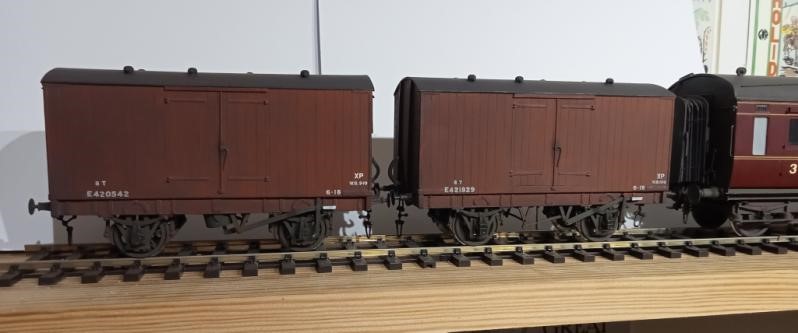
Allan has been beavering away, stripping and repainting some 7mm wagons that had been donated to the Club. He says: “Members might be interested in the attached pictures of the three wagons and two vans kindly donated to the club courtesy of Roy recently, now repaired, modified, painted and weathered. The ex-GNR fitted vans required amendments to the brake gear as well as some additional detailing before repainting, numbering and weathering.

The wagons also required some modifications to the brake gear and further detailing. The short-bodied PO wagon, originally a ‘blank canvas’, has been given a new identity, but any research into the Nene Brick Co of Peterborough will be fruitless! The lettering comes from the NE sheet of decals used for the vans – well, bricks were made around Peterborough so it is feasible! Unfortunately this wagon is sparse in detail and ‘rocks’ on the track so perhaps it is best permanently retired to the back of a siding.”

In addition, this is a rake of LMS vans which Allan has recently finished.
Steve has been working on a model of Verwood station for as long as anyone can remember, or at least since 1992 when he decided Fordingbridge would be too ambitious. Within the scope of this quest is a selection of trains that ran on the Salisbury & Dorset line.
A while before Christmas one of those K’s Milestone Falcon Class kits turned up on Ebay with hardly any of the dodgy underpinnings that would have been discarded, so he put a slightly cheeky bid in and ‘won’ the thing. He had thought that the generic Hattons and Hornby coaches would be suitable for it, but on having a proper look at them, they seemed too modern for what he had in mind from the few photos of LSWR trains that he had seen from the 1880s. Then he remembered perhaps the most famous train on the Salisbury & Dorset – the Salisbury to Weymouth service that derailed at Downton in 1884. The BoT Accident Report is available on-line, makes fascinating reading and gives a very good description of that unfortunate train, including coach numbers and types that he could cross reference to the first of Gordon Weddell’s superb books. Of the event, that cost five lives and caused many injuries, there are no photos, just a couple of lurid drawings that are inconsistent with each other and with the plan in the accident report. So, if anyone has wondered what a Salisbury & Dorset train looked like in the 1880s, this could be their day.
| No. | Description | Compart-ments | Length over Buffers (BoT) | Length over Body | Built | Weddell Page |
| 167 | Passenger Guards Van | 0 | 23’8” | 20’ | 1865 | 52 |
| 429 | Third | 4 | ~21’2” | 19’ | 1865 | 56 |
| 16 | Third | 4 | ~21’2” | 19’ | 1865 | 56 |
| 42 | First | 3 | ~21’2” | 19’ | 1865 | 48 |
| 337 | First | 3 | ~21’2” | 19’ | 1862 | 48 |
| 22 | Second | 4 | ~21’2” | 21’ | 1862 | 51 |
| 43 | Third | 4 | ~21’2” | 19’ | 1865 | 56 |
| 99 | Passenger Guards Van | 0 | 22’10” | 19’ | 1860 | 43 |
Made up into a block set in 1883 at Clapham Junction, but at some point 99 had been substituted for 191 and 16 added probably at Salisbury. 167 was the lead vehicle.

Gordon’s book has drawings and photos of the carriages involved and on Christmas Eve Steve started to use them to 3D model the Third Class coach in OpenSCAD and QCAD as a sort of test to see what was possible. All of the vehicles were modelled in ‘late’ condition as normally photographed, with steps on the ends of each pair of coaches.

Happy with the result, he tackled 167 the passenger guards van. Although a boxy little thing it did come with a ‘caboose’ and the ‘powerful’ Newell Brake that could also brake adjacent carriages. This led him to model the look of that mechanism too, complete with an attempt to portray the curly spoked control wheel and the many bevel gears involved. He then went back to the Third Class coach and gave it the parts of the Newell brakes that I thought it needed.


The First (top) and Second Class (bottom) coaches were next as these had much in common, so were more like tackling one coach. They have a very distinctive look that may be more to do with the Metropolitan Carriage and Wagon Works than the LSWR since the Brighton had some almost identical coaches. The assumption is that the Second Class coach was braked, and the First Class coaches weren’t. These short coaches were close coupled in pairs to help to stabilise them, presumably in a similar way to the suburban block sets.

Bringing up the end of the train was the van that shouldn’t have been there, an externally framed vehicle that has become my personal favourite, whilst we can be certain that all the other vehicles had Mansell wheels, this one it seems had 3’8″ wheels with eight spokes.
All of these coaches and vans have been designed with glazing pockets built in. They have cosmetic W Irons to support the Newell Brake bars, There should be room for Masokits W Irons (externally or internally sprung), as these short little coaches will definitely benefit from suspension. The interiors are modelled with wooden benches in Third Class through to plush seating in First. It seems that the desk and raised platform in both brakes were enclosed to form ‘dog boxes’. Bill Bedford has advised that these coaches should be 3D printed complete with the underframes and separate roof, but just how feasible this will be with current technology remains to be seen. There is a thread on Western Thunder for this unusual project:
https://www.westernthunder.co.uk/threads/downton-train-crash-of-1884-in-em-gauge.12490/
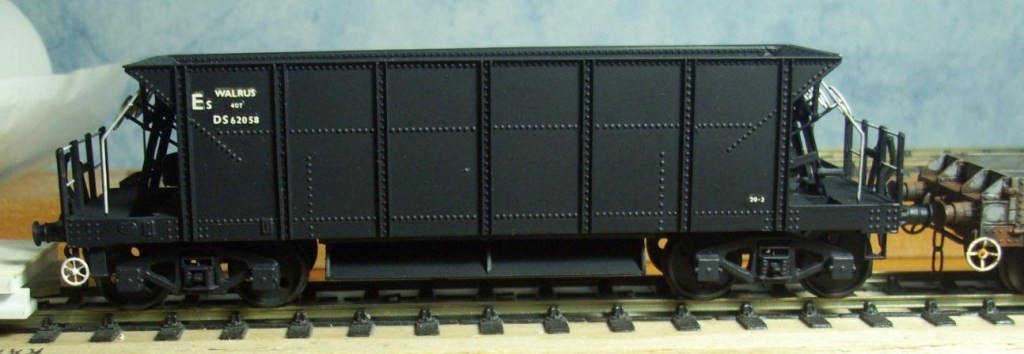

Bringing up the rear (hopefully with brake van and tail light) Peter has built and/or weathered two impressive engineer’s vehicles in 4mm scale/EM Gauge a Cambrian “Walrus” and an Oxford Rail “Pilchard”.

