
This is a structurally detailed model based on the S&D Loco shed at Bath. The prototype was fairly unusual in being so large and built almost entirely of timber,

perhaps even more unusual in that it managed to survive until the end of steam without burning down. In fact the building is known to have caught fire, but apparently the fires were always put out! The prototype was extended several times with the oldest part of the shed being in the north east corner and having a clerestory vents with hipped ends almost identical to the Midland stone loco shed. This shed was widened in a simpler style and then lengthened in that same style. There was a stone built chimney and offices at the far end, and a workshop extension to the north side that had once been the S&D coaling stage. The windows are particularly attractive and the same style of window was used on other buildings at the station. The shed had four roads and was about 300′ long. In the thirties there are photos of it looking rather crisp with glazed louvred clerestory vents plus some rather fine vent stacks. Post-war the building looked extremely tatty in particular with evidence of some very poor quality repairs to and part replacements of the roof and louvred vents.
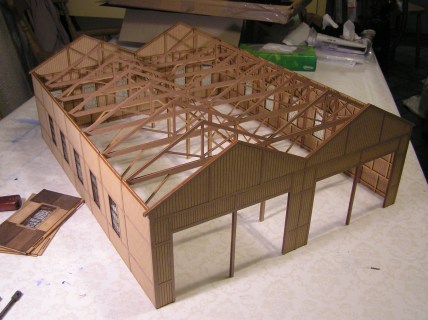
Due to space constraints the model as commissioned is an idealised version using the newer parts of the shed for reference without the stone built offices at the rear or workshop at the side. The basic model is seven bays so scales at about 89′, enabling it to berth a 9F or Bulleid Pacific comfortably. It can be extended in increments of two bays (scales to about 25′) to any required (and manageable) length. The vent stacks

occur every other bay, so extending two bays at a time will preserve the even spacing of the stacks. Construction utilises multiple layers of MDF and card to represent the architectural and structural features of the real shed inside and out. Deluxe Materials Roket Card Glue has proved perfect for the job of gluing it all together as it is easy to use sparingly and develops an effective grab very quickly for a PVA style glue.
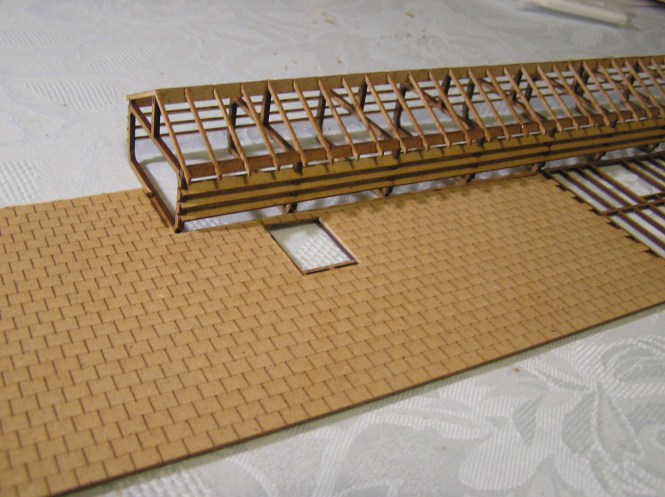
The louvres slot together but still need to be glued. The ridge is glazed and there is a black card overlay to go over the glazing material to represent the top of the glazing bars. The slates are 3D etched, which for this large surface area does take a very long time, but is still much quicker than using laser cut paper or card strips. The sections of slate are joined with a comb joint where the cut (allowing for the kerf) has been finely adjusted as to be almost invisible – there is a join in the picture above!
The model was commissioned by a member of the club and is being designed and test built by the author, with the laser cutting by DCC Train Automation. If anyone is interested in having their own ‘timber cathedral of steam’ they should contact James at DCC Train Automation (01823-429309) who will be able to assist.
 Yeovil Model Railway Group (YMRG)